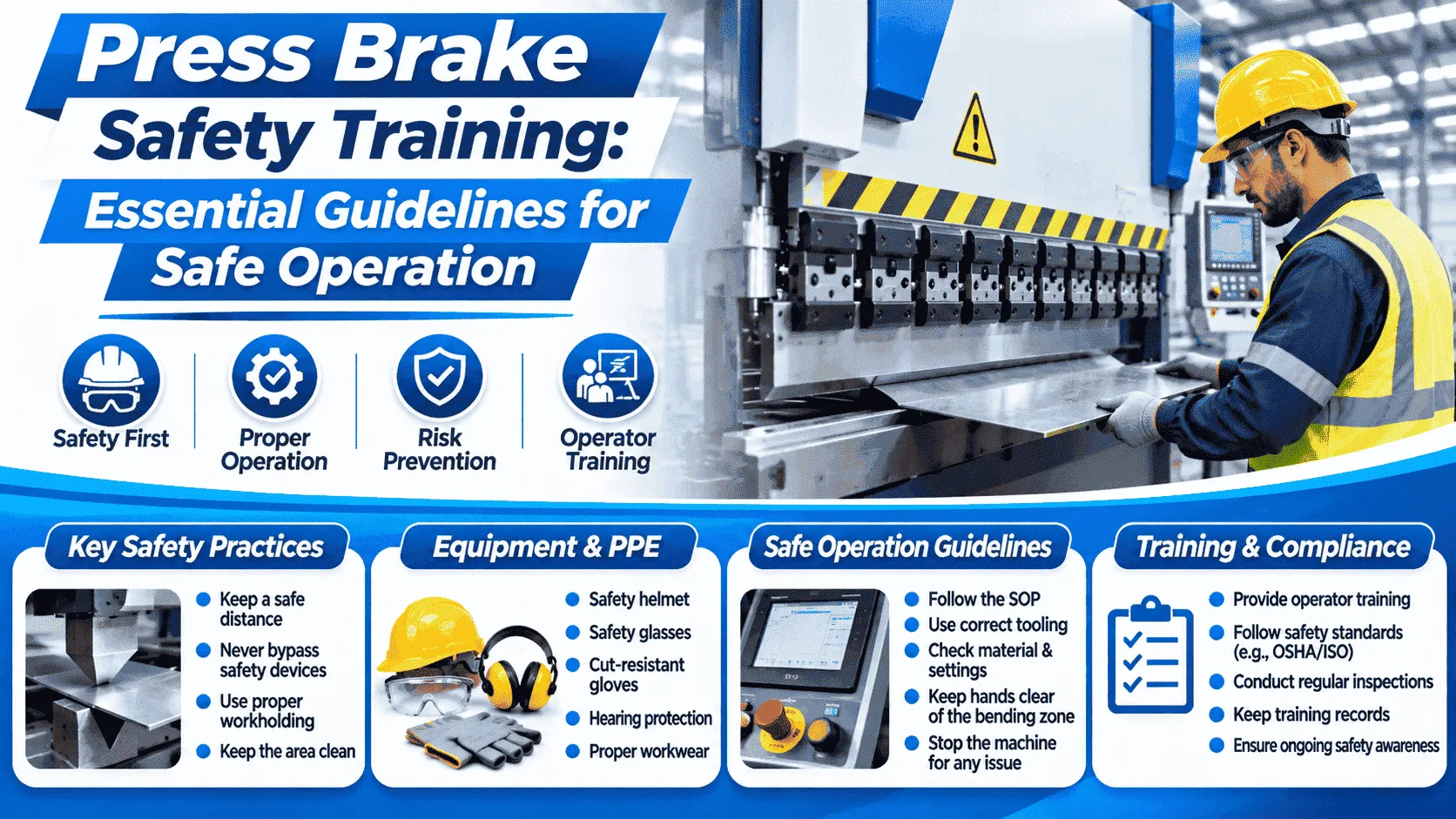
Press brakes play an important role in sheet metal fabrication, but operating these machines without proper safety knowledge can expose workers to serious injuries. High bending forces, moving components, sharp metal sheets and automated machine cycles make operator awareness essential in every fabrication workshop.
Press brake safety training teaches operators how to identify machine hazards, use protective devices, follow safe operating procedures and respond to unexpected situations. Whether a workshop uses a conventional hydraulic press brake or an advanced CNC press brake machine, every operator must understand the risks before starting production.
A well-structured safety programmed also improves production consistency, reduces equipment damage and helps manufacturers maintain a safer working environment. This guide explains essential press brake safety practices, operator responsibilities, machine guarding methods and maintenance procedures.
1. Why Is Press Brake Safety Training Important?
A press brake applies substantial force to bend sheet metal between a punch and a die. During this process, the ram moves toward the worktable while the operator positions, supports and handles the material.
Even a moment of inattention can expose an operator’s hands or fingers to dangerous moving components.
Proper press brake operator training helps workers:
- Recognize pinch points and crushing hazards.
- Understand machine controls and operating modes.
- Maintain safe hand positioning during bending.
- Use machine guards and safety devices correctly.
- Handle sharp and heavy metal sheets safely.
- Follow emergency shutdown procedures.
- Perform routine inspections before production.
Safety training should cover the specific machine model, installed safeguarding equipment and assigned operating tasks.
2. Common Press Brake Hazards Operators Must Understand
Before operating a press brake, workers should understand where injuries can occur and why particular activities create risks.
| Press brake hazard | Potential risk | Recommended prevention |
|---|---|---|
| Point of operation | Fingers or hands trapped between punch and die | Use suitable machine guarding |
| Moving ram | Crushing injuries | Maintain safe clearance |
| Sharp sheet metal | Cuts and punctures | Use suitable protective equipment |
| Material movement | Shifting or falling sheets | Use appropriate material supports |
| Foot pedal activation | Accidental machine cycling | Use guarded pedals |
| Tooling installation | Injuries during tool changes | Follow approved setup procedures |
| Hydraulic system failure | Leaks or unexpected movement | Inspect hydraulic components |
| Poor housekeeping | Slips and trips | Keep the work area clear |
Point-of-Operation Hazards
The point of operation is where the punch and die come together to form the metal sheet. This is one of the most critical areas to protect during press brake operation.
Operators must never place their hands or fingers inside the danger zone while the machine is cycling.
Pinch Points and Crushing Hazards
Press brakes contain several moving areas, including the ram, tooling and back gauge. Contact with these components can cause serious injuries.
Operators must identify hazardous areas and follow the machine’s designated safeguarding procedures.
Material Handling Hazards
Large or heavy metal sheets can become difficult to control during bending. As the machine forms the material, the sheet may move upward or change position unexpectedly.
Use suitable material support equipment and trained helpers when the job requires additional handling assistance.
3. Essential Press Brake Safety Devices and Machine Guarding
Machine guarding reduces operator exposure to dangerous moving parts. The correct safeguarding arrangement depends on machine design, tooling, material dimensions and production processes.
Safety Light Curtains
Safety light curtains create a protected sensing field around a hazardous machine area. If an object interrupts the sensing field under configured operating conditions, the safety system initiates its designed protective response.
Operators should inspect the system, keep its sensing field unobstructed and never bypass or disable its protective functions.
Laser-Based Safety Systems
Some modern CNC press brakes use laser-based protection systems near the tooling area. These systems monitor the hazardous area and can initiate a protective stop when they detect an intrusion within their configured protection zone.
Operators must understand the installed system’s detection limits and inspection requirements.
Two-Hand Controls
Two-hand controls require the operator to activate designated controls using both hands. When correctly designed and configured, they help keep the operator’s hands away from the point of operation during the protected part of the machine cycle.
Physical and Interlocked Guards
Physical guards prevent workers from accessing dangerous moving components. Interlocked guards connect the protective enclosure to the machine control system and initiate the designed safety response when opened.
Operators must never remove or modify these guards.
Emergency Stop Buttons
Emergency stop buttons allow operators to initiate an emergency machine stop when an unsafe condition occurs. Every operator should know their locations and understand the approved reset procedure.
An emergency stop does not replace machine guarding or energy-isolation procedures.
4. Press Brake Safety Checklist Before Starting a Machine
A pre-operation inspection helps identify problems before they become serious incidents.
| Inspection area | What to check |
|---|---|
| Machine condition | Visible damage and loose components |
| Safety guards | Correct installation and condition |
| Light curtains | Condition and approved functional tests |
| Emergency stops | Operation according to test procedures |
| Foot pedal | Protective cover and cable |
| Hydraulic system | Visible leaks and damaged hoses |
| Punch and die | Condition, alignment and secure clamping |
| CNC controller | Correct program and operating mode |
| Work area | Clear access and proper housekeeping |
| Material support | Suitable support for the workpiece |
When preparing the machine, operators must also confirm that the selected tooling matches the material and bending requirements. Correct press brake tooling selection helps prevent unsuitable setups and unnecessary tooling-related risks.
If an operator discovers a faulty guard, damaged control or abnormal machine condition, production should not begin until an authorized person has assessed the problem.
5. Safe Press Brake Operating Procedures
Following a consistent operating procedure helps reduce mistakes during sheet metal bending.
Step 1: Review the Job Requirements
Read the work order and confirm material type, thickness, dimensions, bending sequence and finished part requirements.
A properly planned sheet metal press brake bending sequence helps operators understand the order of operations before production begins.
Step 2: Select and Inspect the Tooling
Choose the appropriate punch and die for the material and bending operation.
Check tooling for cracks, deformation and excessive wear. Follow the manufacturer’s instructions when installing or changing tools.
Step 3: Configure the CNC Program
Enter or load the correct bending program and verify its parameters. Check material specifications, bending angles, back gauge positions and operating sequences.
Operators should also understand how the machine’s programmed settings relate to its required press brake tonnage to avoid incorrect setups and excessive machine loading.
Step 4: Check Safety Devices
Confirm that all required guards and protective systems are installed, functional and configured for the selected operating mode.
Never start the machine when a required safety device is faulty or bypassed.
Step 5: Position the Sheet Metal
Place the workpiece against the back gauge according to the approved operating procedure.
Keep hands away from the punch and die area. Use appropriate material supports when the sheet requires additional assistance.
Step 6: Perform a Controlled Test Bend
Where the job procedure requires it, perform an initial test bend using the approved setup and operating mode.
Check the result against the drawing and confirm that the machine operates as expected before continuing production.
Step 7: Monitor the Bending Operation
Maintain attention throughout the machine cycle.
Keep clear communication with any helper, monitor material movement and stop the operation if an unexpected condition develops.
Step 8: Remove and Inspect the Finished Part
Remove the bent sheet using the approved handling method. Watch for sharp edges, unstable material and unexpected movement.
Check the finished part for dimensional and angular accuracy.
6. Personal Protective Equipment (PPE) for Press Brake Operators
Personal protective equipment provides an additional layer of protection against workplace hazards.
| PPE | Purpose |
|---|---|
| Safety glasses | Protect eyes from flying particles |
| Safety footwear | Protect feet from heavy materials |
| Suitable hand protection | Reduce exposure to sharp sheet metal edges during approved handling |
| Hearing protection | Reduce harmful noise exposure when required |
| Protective clothing | Reduce exposure to workplace hazards |
Important: Gloves are not automatically suitable for every press brake task. Loose or unsuitable gloves can create entanglement hazards around moving machinery. Follow the manufacturer’s instructions and workplace risk assessment.
Operators should also avoid loose sleeves, jewelry and unsecured long hair around moving equipment.
7. Press Brake Maintenance Safety and Lockout/Tagout
Maintenance and troubleshooting can expose workers to hazardous energy, including electrical power, hydraulic pressure and unexpected machine movement.
Before performing maintenance, cleaning inside hazardous areas or replacing components, authorized personnel must follow the applicable energy-isolation procedure.
Essential Maintenance Safety Practices
- Stop the machine using the approved shutdown procedure.
- Isolate all relevant energy sources.
- Apply lockout/tagout where required.
- Release or safely control stored energy.
- Verify the isolated condition before beginning work.
- Allow only authorized personnel to perform maintenance.
- Reinstall guards and inspect the machine before returning it to production.
Never assume that switching off the CNC controller or pressing the emergency stop button completely isolates hazardous energy.
Routine Maintenance Inspection
| Component | Maintenance consideration |
|---|---|
| Hydraulic system | Inspect fluid levels, hoses and connections |
| Electrical components | Check visible damage |
| Safety devices | Inspect and test according to the manufacturer’s schedule |
| Punch and die | Check wear and damage |
| Back gauge | Inspect movement and positioning |
| Machine frame | Look for visible damage |
| Control system | Report alarms and unusual behaviour |
Maintenance intervals should follow the manufacturer’s recommendations and actual operating conditions.
8. Common Press Brake Safety Mistakes to Avoid
Even experienced operators can develop unsafe habits when production pressure increases.
- Bypassing safety devices: Never disable a light curtain or interlock to increase production speed.
- Reaching into the die area: Keep hands outside the hazardous point of operation.
- Using damaged tooling: Replace or report cracked, worn or deformed tools.
- Ignoring unusual machine behaviour: Stop and report unexpected noises or movements.
- Operating without authorization: Only trained and authorized personnel should operate the machine.
- Ignoring material movement: Support large or unstable sheets appropriately.
- Performing unauthorized repairs: Follow energy-isolation procedures.
- Working with poor communication: Establish clear responsibilities when multiple workers handle a job.
A strong safety culture requires operators, supervisors and maintenance personnel to follow the same established procedures.
9. How to Build an Effective Press Brake Operator Training Programmed
A successful press brake safety training programmed should combine theoretical instruction with practical machine training.
Recommended Training Modules
| Training module | Key learning objectives |
|---|---|
| Machine fundamentals | Understand machine components and controls |
| Hazard identification | Recognize pinch points and crushing hazards |
| Safety devices | Understand guarding and emergency stops |
| Tooling and setup | Learn approved installation procedures |
| Safe operation | Demonstrate correct material positioning |
| PPE | Select suitable protective equipment |
| Emergency response | Understand shutdown and incident reporting |
| Maintenance safety | Understand energy isolation |
Operator Competency Assessment
Supervisors should evaluate each operator through practical demonstrations.
An operator should demonstrate the ability to identify hazardous areas, complete pre-operation inspections, recognize faulty safety devices, position material safely and follow emergency procedures.
Document training completion and competency assessments. Provide refresher training whenever equipment, tooling or operating procedures change.
10. How CNC Press Brake Technology Supports Safer Production
Modern CNC press brakes offer advanced controls, programmed movements and integrated safety features that support consistent production.
However, automation does not remove the need for operator training or appropriate safeguarding.
When selecting a machine, manufacturers should evaluate:
- Available safety guarding configurations.
- Emergency stop accessibility.
- Foot pedal protection.
- CNC operating modes and access controls.
- Material support requirements.
- Maintenance accessibility.
- Operator training and technical support.
Different machine designs may offer different operating and control configurations. For example, an all-electric servo CNC bending machine uses an electric servo-driven transmission system, while a large hybrid CNC bending machine combines servo technology with hydraulic power.
Manufacturers should assess the actual guarding and safety equipment fitted to each machine rather than assuming that a particular drive system automatically makes a machine safer.
11. Press Brake Safety Training: Daily Operator Checklist
Operators can use this quick checklist to reinforce safe working practices throughout their shifts.
Before operation
- Inspect the machine and work area.
- Check required guards and safety devices.
- Test emergency stops according to the approved procedure.
- Inspect tooling and the foot pedal.
- Confirm the correct CNC program.
- Wear required PPE.
During operation
- Keep hands away from the point of operation.
- Maintain a safe working position.
- Support large sheets appropriately.
- Monitor material movement.
- Maintain communication with helpers.
- Stop and report unexpected conditions.
After operation
- Follow the approved shutdown procedure.
- Remove finished parts safely.
- Clean the work area using approved methods.
- Report faults or damaged components.
- Complete production and safety records.
Frequently Asked Questions About Press Brake Safety Training
1. What is press brake safety training?
Press brake safety training teaches operators how to identify machine hazards, use protective devices, handle sheet metal safely and follow approved operating procedures. It also covers emergency response, PPE and maintenance safety.
2. What are the most common press brake hazards?
The main hazards include point-of-operation injuries, pinch points, crushing injuries, sharp sheet metal edges, unexpected material movement, accidental machine activation and exposure to hazardous energy during maintenance.
3. What safety devices are used on a press brake?
Common press brake safety devices include safety light curtains, laser-based guarding systems, physical guards, interlocked guards, two-hand controls, guarded foot pedals and emergency stop buttons.
4. Are safety light curtains necessary on every press brake?
Not every press brake uses the same safeguarding arrangement. The required protection depends on machine design, operating processes, risk assessment and applicable safety regulations.
5. Can operators wear gloves when using a press brake?
Operators should use suitable hand protection when handling sharp sheet metal, but gloves can create entanglement hazards around moving machinery. Follow the manufacturer’s instructions and workplace risk assessment.
6. How often should press brake operators receive safety training?
Operators should receive training before operating a machine independently. Refresher training should follow significant equipment or procedure changes, identified competency gaps or unsafe practices.
7. What should an operator check before starting a press brake?
An operator should inspect the machine, guards, safety devices, emergency stops, foot pedal, tooling, hydraulic components where applicable, CNC program and surrounding work area.
8. Why is lockout/tagout important during press brake maintenance?
Lockout/tagout helps prevent unexpected machine activation and exposure to hazardous energy during servicing and maintenance. Authorized personnel must isolate relevant energy sources and verify the safe condition before beginning work.
9. Does a CNC press brake eliminate operator safety risks?
No. CNC automation improves positioning and process control, but operators can still face crushing, pinch-point, material-handling and maintenance hazards. Proper safeguarding and operator training remain essential.
10. Who should be allowed to operate a press brake?
Only workers who have received appropriate machine-specific training, demonstrated competency and obtained workplace authorization should operate a press brake.
Conclusion
Press brake safety training is essential for protecting machine operators, maintaining reliable production and reducing workplace risks in sheet metal fabrication.
A complete safety programme combines hazard awareness, effective machine guarding, pre-operation inspections, safe bending procedures, suitable PPE and proper maintenance practices.
By combining trained operators with correctly configured CNC press brake safety systems, fabrication businesses can create a safer and more productive working environment.