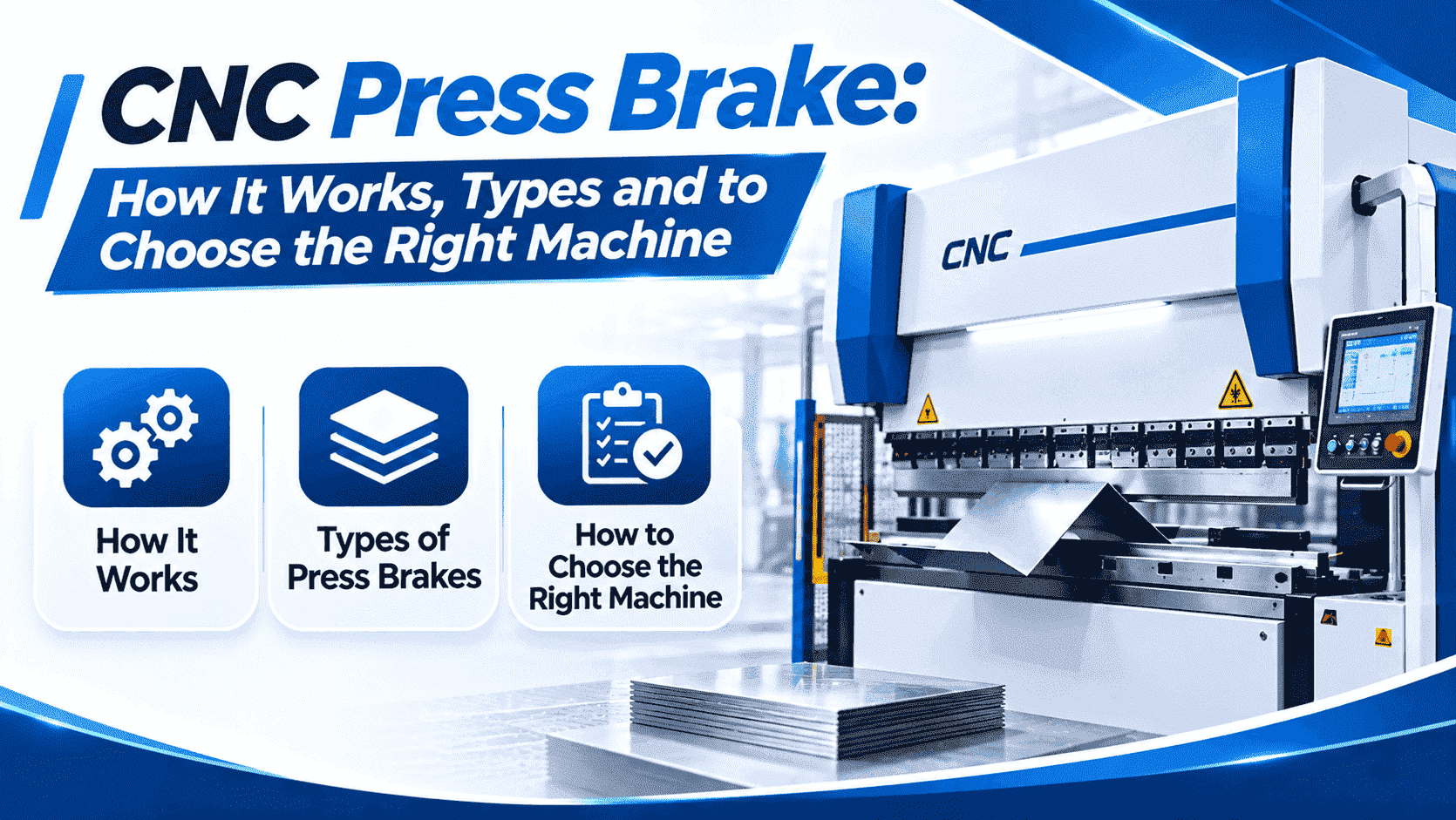
A CNC press brake is a sheet metal bending machine that uses a computer numerical control system to position the ram and the back gauge automatically. The operator loads a stored program and places the sheet against the back gauge, and the machine forms each bend to the programmed angle and flange length. That control makes a CNC press brake the standard choice for shops that need repeatable angles, fast changeovers and less trial and error than a manual machine allows.
This guide explains how a CNC press brake works, what each major part does, how the main drive types differ, how to read a spec sheet and how to choose a machine that fits your parts. It also covers controllers, axes, safety and daily care, so you can compare quotes with confidence.
At a glance
- What it does: bends sheet metal and plate to programmed angles with a punch and a V-die.
- What sets quality: frame rigidity, ram synchronization, back gauge accuracy, crowning and tooling.
- Main drive options: torsion shaft, electro-hydraulic servo, three-cylinder, dual servo pump, hybrid and all-electric.
- Numbers to compare: nominal force, bending length, throat depth, stroke, open height and back gauge axes.
What Is a CNC Press Brake?
A CNC press brake, also called a CNC press brake machine or a CNC brake press, forms sheet metal by pressing it between an upper punch and a lower V-die. The terms press brake and brake press describe the same type of machine, so both names lead to the same equipment.
The “CNC” part means a computer controls every motion. On a manual machine, the operator sets the stops and the bending depth by hand. A CNC press brake calculates the ram depth and the back gauge positions from the part data and repeats them exactly on every stroke.
Shops choose a CNC press brake for five practical reasons:
- Repeatable angles. The controller and the position sensors hold the same ram depth from the first part to the thousandth.
- Fast setup. Stored programs bring back a job in minutes, which suits repeat orders and mixed batches.
- Less scrap. The controller calculates the bend depth and sequence, so operators spend less time on trial bends.
- Multi-bend parts. The back gauge moves automatically between bends, so one operator can form a complex part in a single pass.
- Less dependence on skill. Programming and stored data replace much of the manual adjustment that experienced operators once did by feel.
How a CNC Press Brake Works
Every CNC press brake machine follows the same basic cycle, whatever its size or brand:
- Program the part. The operator enters the material, thickness, bend angles and flange lengths. Many controllers also import 2D or 3D drawings and calculate the bend sequence automatically.
- Set up the tooling. The operator clamps a punch to the ram and a V-die to the worktable. The die opening depends on the sheet thickness and the bend radius.
- Position the back gauge. Servo motors move the back gauge fingers to the programmed position, so the sheet lands exactly where the bend line falls.
- Bend the sheet. The ram moves down, and the punch presses the sheet into the die. Linear encoders report the ram position to the controller, which keeps both ends of the ram level.
- Compensate for deflection. A crowning system adjusts the worktable so the angle stays constant along the full bending length.
- Measure and correct. The operator checks the first part, enters any angle correction and saves it. The controller applies the correction to every later part.
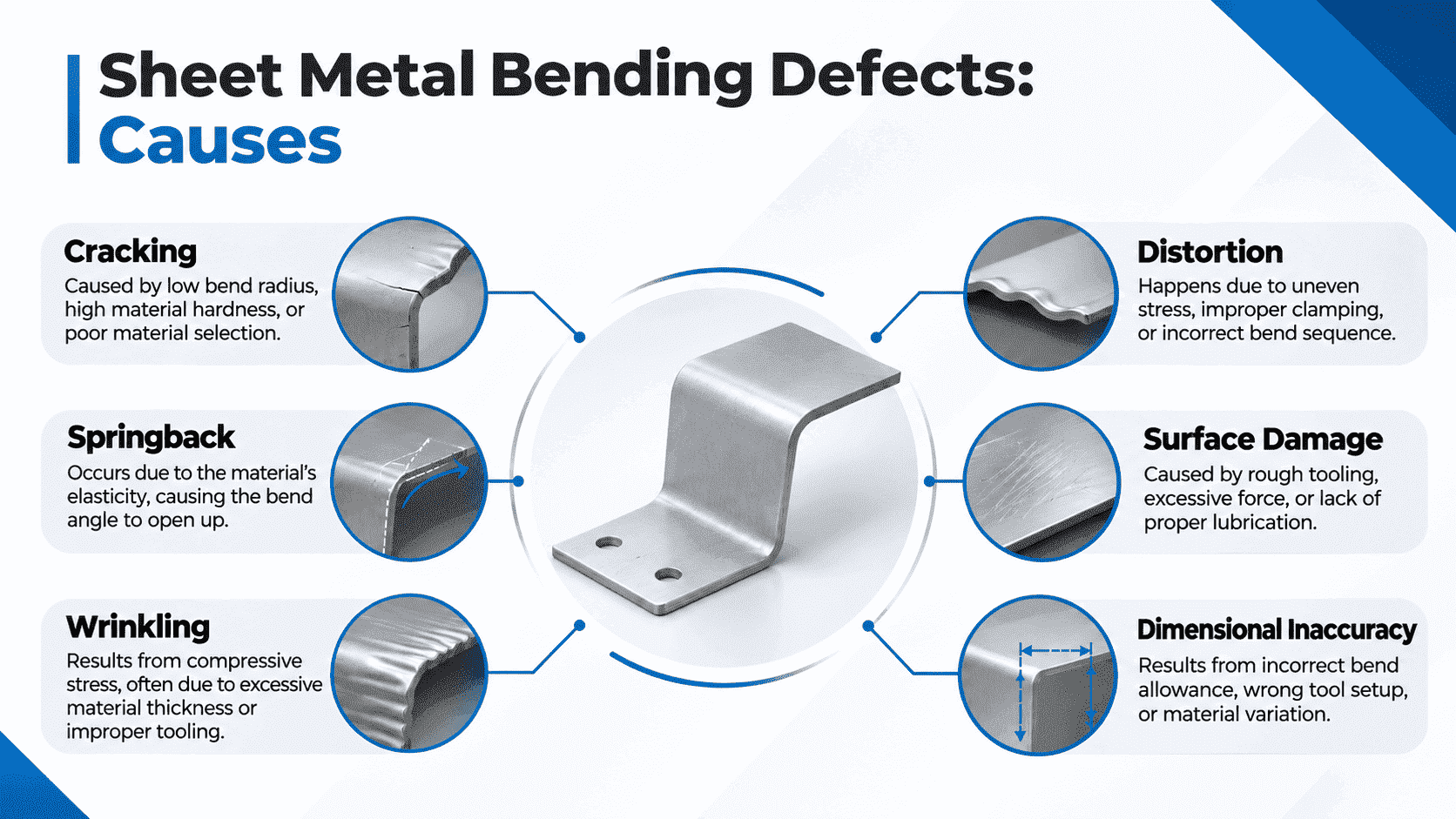
Springback pulls every bent sheet slightly back toward its flat shape. A CNC press brake offsets it by bending a little past the target angle, and our guide to sheet metal bending defects explains how to fix angle errors, cracks and other faults when they appear.
Bending Methods on a CNC Press Brake
| Method | How it works | Strength | Trade-off |
|---|---|---|---|
| Air bending | The punch pushes the sheet into the die without touching the die bottom, and the ram depth sets the angle | One tool set makes many angles, and the machine needs less force | Needs precise depth control and springback compensation |
| Bottoming | The punch presses the sheet against the die faces | Better angle repeatability | Needs more force, and the die angle must match the target angle |
| Coining | The punch forces the material into the die with very high force | Almost no springback | Highest force and faster tool wear |
Most CNC press brakes run air bending most of the time, because one set of tools covers a wide range of angles.
Main Parts of a CNC Press Brake Machine
Eight components decide how accurately a CNC press brake bends. Check each one when you compare machines.
| Component | What it does | What to check |
|---|---|---|
| Frame, ram and worktable | Carries the bending load and keeps the tools aligned | Welded, stress-relieved steel structure and machined mounting surfaces |
| Drive and synchronization | Creates the bending force and keeps both ends of the ram level | Drive type: torsion shaft, servo-hydraulic, hybrid or electric |
| Linear encoders | Tell the controller where the ram is | Mounting position, resolution and protection from dust and vibration |
| CNC controller | Stores programs, calculates depth and drives the axes | Screen size, graphical programming and ease of use |
| Back gauge | Positions the sheet for every bend | Number of axes, ball screws, linear guides and finger design |
| Crowning system | Offsets ram and table deflection | Hydraulic or mechanical, manual or automatic |
| Tooling and clamping | Forms the bend | Quick clamping, segmented punches and hardened tool surfaces |
| Safety system | Protects the operator | Light curtains or laser guards, foot pedal, emergency stop and guarding |
CNC Press Brake vs NC Press Brake vs Manual Press Brake
The control level changes what the machine does for you. Use this table to see where a CNC press brake fits.
| Factor | Manual press brake | NC press brake | CNC press brake |
|---|---|---|---|
| Control | Operator sets stops and depth by hand | Basic numerical control with limited axes | Full computer control of ram and back gauge |
| Programming | None | Simple step entry | Stored programs, often with graphical or 3D input |
| Back gauge | Manual or simple | Usually one or two axes | Multi-axis servo back gauge |
| Angle repeatability | Depends on the operator | Moderate | High, with encoder feedback |
| Setup time | Longer for each job | Medium | Short for repeat jobs |
| Best use | Simple, low-volume bends | Standard parts on a tight budget | Accurate, repeat and complex parts |
Types of CNC Press Brakes by Drive System
The drive system decides how the machine creates force, how it keeps the ram level and how much energy it uses. Xinli Machinery builds six types, and each one suits a different shop.
| Drive type | How it works | Strengths | Trade-offs | Best fit |
|---|---|---|---|---|
| Torsion shaft CNC | A mechanical torsion shaft links the two cylinders and keeps the ram level | Simple structure, easy maintenance, lower cost | Less flexible than fully servo-controlled systems | Standard bending in small and medium workshops |
| Electro-hydraulic servo CNC | Servo valves and linear encoders control each cylinder in a closed loop | High accuracy and stable synchronization | Higher cost than torsion shaft machines | Precision work and mixed production |
| Three-cylinder CNC | A third cylinder helps spread the force across the beam | Balanced force on long machines | Larger and heavier | Long parts and higher tonnage |
| Dual servo pump-controlled | Two pumps with a servo motor switch between flow modes as the load changes | Lower energy use and quieter running | More components to specify | Shops with long running hours |
| Large hybrid CNC | Servo technology drives the hydraulic power unit | Hydraulic strength with lower energy use | Needs correct sizing for the job | Heavy-duty, large-scale production |
| All-electric servo CNC | Electric servo motors replace the hydraulic power unit | Fast response, clean running and high precision | Better suited to light and medium capacity | Precision parts in clean workshops |
Why the CNC Hydraulic Press Brake Still Leads
A CNC hydraulic press brake remains the most common choice for good reasons. Hydraulic cylinders deliver high force across the full bending length, so one machine handles thick plate and light sheet alike. Technicians also understand the technology well, and spare parts and service are easy to find.
Modern designs fix the old weaknesses. Servo motors now drive the pumps, which cuts idle energy use and noise. Closed-loop valves and linear encoders keep the ram parallel, so a CNC hydraulic press brake can match the accuracy that once required an electric machine. Xinli states that its dual servo pump design saves more than 50% energy, and the large hybrid model aims at the same goal for heavy-duty work.
Hydraulic machines still need oil checks, filter changes and clean oil. Plan these tasks into your maintenance schedule from day one.
When an All-Electric CNC Press Brake Makes Sense
An all-electric CNC press brake suits shops that value speed, cleanliness and fine control. The Xinli all-electric servo CNC bending machine uses a fully closed-loop electric servo system with magnetic linear scales on both sides of the ram. Its listed model delivers 400 kN over a 1500 mm table, so it fits light and medium sheet work. For heavy plate and long beams, a hydraulic or hybrid machine gives you more capacity.
CNC Controllers and Axes
The controller is the brain of the machine. It decides how fast you can program a job and how many functions you can use.
| Controller | Where to learn more |
|---|---|
| DELEM | DELEM CNC system |
| CYBELEC | CYBELEC CNC system |
| ESA | ESA CNC system |
| Syntec | Syntec CNC system |
Xinli fits a DELEM DA53TX system to its electro-hydraulic and dual servo pump models, and the all-electric model carries an Inovance EP700B system with a 15-inch touchscreen. The three-cylinder model offers a 10-inch touchscreen, menu-style programming and angle programming that calculates the bending depth automatically. Browse the full CNC system range to compare options.
Press Brake Axes Explained
Each axis adds a movement the controller can program. More axes mean more flexibility and faster setups.
| Axis | Movement | Purpose |
|---|---|---|
| Y1 and Y2 | The left and right ends of the ram move independently | Control ram depth and keep the ram parallel |
| X | The back gauge moves forward and backward | Sets the flange length |
| R | The back gauge fingers move up and down | Adapts to different die heights and supports the sheet |
| Z1 and Z2 | The fingers move left and right | Position the stops for small, offset or asymmetric parts |
| V (crowning) | The worktable crowning adjusts | Keeps the angle constant along the length |
Many machines ship with Y, X and R as standard, and extra Z axes add flexibility for varied work. The dual servo pump-controlled model uses an X, R, Z and Y four-axis linkage.
Where Shops Use CNC Press Brakes
| Industry | Typical bent parts | Why a CNC press brake helps |
|---|---|---|
| Electrical and switchgear | Cabinets, enclosures and panels | Repeatable flanges keep doors and covers aligned |
| Automotive | Brackets, frames and reinforcements | Stored programs support steady, repeat production |
| Construction and steel structures | Channels, plates and cladding profiles | Long tables and high tonnage handle large parts |
| Aircraft and shipbuilding | Structural and heavy plate parts | Accurate control reduces rework on costly materials |
| Electronics and computers | Housings and chassis | Fine back gauge control keeps tolerances tight |
| Job shops | Mixed, small-batch orders | Fast changeovers keep the machine earning |
How to Choose a CNC Press Brake
Follow these seven steps to avoid buying a machine that is too small, too slow or too complex.
- List your parts. Record the material, the maximum thickness, the longest bend and the smallest flange for every part family.
- Calculate the force you need. Bending force rises with material strength and bend length. At the same V-die opening, doubling the thickness roughly quadruples the force. A wider V-die lowers the force. Leave a safety margin so the machine does not work at its limit every day.
- Match the bending length. Choose a table that fits your longest part with room to spare, because the table length and the distance between the columns limit your part size.
- Check throat depth, stroke and open height. Deep boxes and tall tools need more throat depth and daylight. Our spec table below shows how these numbers change by model.
- Pick the drive system. Use the table above to match torsion shaft, servo-hydraulic, hybrid or electric drive to your accuracy needs, running hours and energy goals.
- Select the controller and axes. Choose a controller your team can learn quickly, and add axes only when your parts need them.
- Plan tooling, safety and service. Budget for punches, dies and quick clamps. Confirm the safety system, the warranty, the spare parts supply and the training your supplier provides.
Example: How to Read a Spec Sheet
The table below shows four models from the Xinli WF67K series. Use it as a template for reading any CNC press brake spec sheet.
| Model | Nominal force (kN) | About (metric tons-force) | Table length (mm) | Column distance (mm) | Throat depth (mm) | Stroke (mm) | Open height (mm) | Main motor (kW) |
|---|---|---|---|---|---|---|---|---|
| WF67K-40/1500 | 400 | 41 | 1500 | 1160 | 320 | 160 | 410 | 5.5 |
| WF67K-80/2500 | 800 | 82 | 2500 | 2000 | 400 | 200 | 470 | 7.5 |
| WF67K-100/3200 | 1000 | 102 | 3200 | 2700 | 400 | 250 | 525 | 7.5 |
| WF67K-100/4000 | 1000 | 102 | 4000 | 3500 | 400 | 250 | 525 | 7.5 |
- Model code: the first number is the nominal force, and the second number is the table length. WF67K-100/3200 means 1000 kN over 3200 mm.
- Nominal force: the maximum force the machine delivers. It does not apply across every bend length at full value, so check the load chart for your tooling.
- Column distance: the clear width between the side frames. It limits the widest sheet that passes through the machine.
- Throat depth: the distance from the tool line to the frame. It limits how far a sheet can enter the machine.
- Stroke and open height: together they set how tall your tooling and your formed part can be.
The electro-hydraulic CNC bending machine with follow-up material support in this series adds an intelligent support device that helps keep long plates from deforming during the bend. For higher capacity, see the large-tonnage electro-hydraulic servo CNC bending machine.
Quick Pick by Shop Profile
| Your shop | Usual best fit | Why |
|---|---|---|
| Standard parts, small to medium volume, tight budget | Torsion shaft CNC | Simple, durable and cost effective |
| Mixed work that demands high accuracy | Electro-hydraulic servo CNC | Closed-loop control keeps angles consistent |
| Long beams and heavy plate | Three-cylinder or large hybrid CNC | Balanced force and high capacity |
| High running hours and energy cost pressure | Dual servo pump or hybrid CNC | Lower energy use at low load |
| Light to medium precision parts | All-electric servo CNC | Fast, clean and precise |
What Affects the Price of a CNC Press Brake?
No single price fits every machine. These seven factors move the budget the most.
| Cost driver | Why it matters | How to keep it under control |
|---|---|---|
| Tonnage and length | Larger frames and cylinders cost more | Size the machine for your real parts, not your rarest job |
| Drive system | Servo, hybrid and electric systems cost more than torsion shaft | Match the drive to your accuracy and running hours |
| Controller | Advanced controllers add programming functions | Choose features your team will use |
| Back gauge axes | Extra axes add motors and guides | Add axes only for parts that need them |
| Crowning | Automatic crowning costs more than manual | Choose automatic crowning for long tables and varied thickness |
| Tooling | Quality dies and quick clamps add cost | Buy a core tool set first and expand later |
| Safety and service | Guarding, training and warranty change the quote | Ask for one itemized quote from every supplier |
Safety and Daily Care for a CNC Press Brake
A press brake works close to the operator, so safety and care go together.
Safety basics
- Fit light curtains, laser guards or equivalent protection, and check them every shift.
- Test the emergency stop and the foot pedal before each shift.
- Train every operator on the controller, the tooling and the lockout procedure.
- Follow the safety standard that applies in your market.
Daily and weekly care
- Check the hydraulic oil level and look for leaks on a CNC hydraulic press brake.
- Clean and lubricate the guides, the back gauge ball screws and the tool clamps.
- Inspect punches and dies for wear, chips and cracks.
- Verify the back gauge zero position and run a test bend to confirm the angle.
- Keep the linear encoders and the control cabinet clean and dry.
Build One Connected Metal Fabrication Workflow
A CNC press brake works best when it receives accurate blanks. A fiber laser cutting machine produces precise blanks for complex outlines, and our guide to fiber laser cutting cost per hour helps you budget that step. For simple rectangular blanks, shearing machines cut sheet at a lower cost.
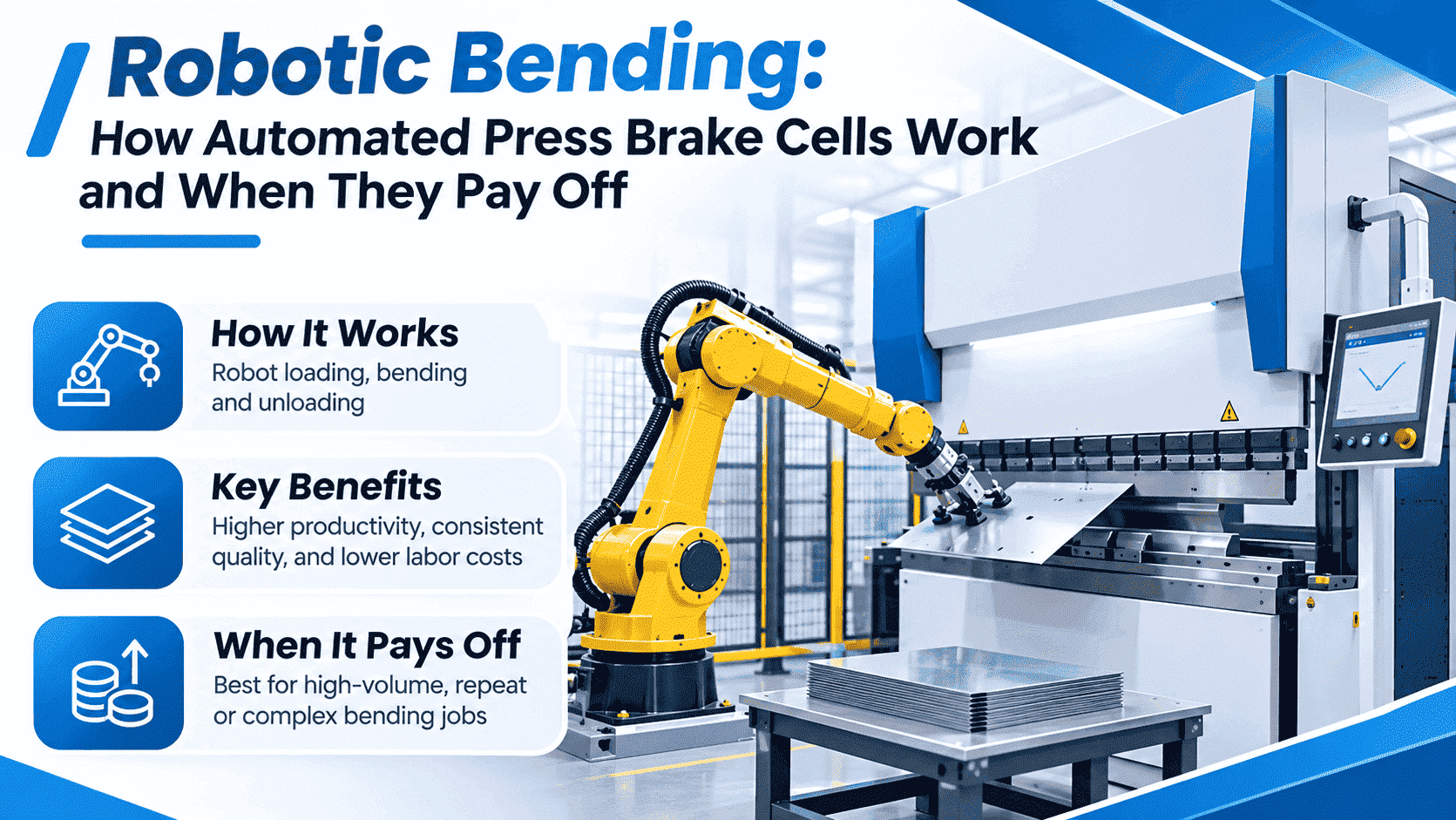
When your repeat volume grows, add automation. Our guide to robotic bending explains how automated press brake cells work and when they pay off.
CNC Press Brake FAQs
What is a CNC press brake?
A CNC press brake is a sheet metal bending machine that uses computer numerical control to move the ram and the back gauge. The operator loads a program, and the machine bends each part to the programmed angle and flange length with a punch and a V-die. It delivers more repeatable results than a manual machine.
How does a CNC press brake work?
A CNC press brake works in a repeating cycle. The controller moves the back gauge to the programmed position, and the operator places the sheet against it. The ram then drives the punch into the V-die and forms the bend. Linear encoders keep the ram level, and the crowning system keeps the angle even along the length.
What is the difference between a press brake and a brake press?
There is no difference. Press brake and brake press describe the same machine, and shops use both names. A CNC brake press is simply a press brake with computer control, so the two search terms lead to the same type of equipment.
What is the difference between a CNC press brake and an NC press brake?
An NC press brake offers basic numerical control with limited axes, while a CNC press brake gives full computer control of the ram and a multi-axis back gauge. A CNC press brake stores programs, calculates bend depth and supports graphical programming. That makes it better for complex, repeat and high-accuracy work.
What is a CNC hydraulic press brake?
A CNC hydraulic press brake uses hydraulic cylinders to create the bending force and a CNC controller to guide the ram and the back gauge. It delivers high force across the full bending length, so it handles both thin sheet and thick plate. Modern servo-driven versions use less energy and run more quietly.
Which is better: a hydraulic, hybrid or all-electric CNC press brake?
The best choice depends on your parts. A hydraulic machine offers high force and easy service. A hybrid machine cuts energy use while keeping hydraulic strength. An all-electric machine delivers fast, clean, precise bending for light and medium capacity. Match the drive to your thickness range, running hours and accuracy needs.
What axes does a CNC press brake have?
Most CNC press brakes control the ram with Y1 and Y2 axes and the back gauge with X and R axes. Many machines add Z1 and Z2 axes to move the fingers sideways, and a crowning axis to keep the angle even along the length. More axes give more flexibility for complex parts.
How do I choose the right tonnage and length for a CNC press brake?
Start with your thickest material and your longest bend. Bending force rises with material strength, thickness and bend length, and it falls as the V-die opening widens. Choose a machine with a safety margin above your calculated force, and a table long enough for your longest part.
What materials can a CNC press brake bend?
A CNC press brake bends mild steel, stainless steel, aluminum, copper and brass, among other sheet metals. The machine force, the tooling and the minimum bend radius of the material set the limits. Harder and thicker materials need more tonnage and wider V-dies.
How much does a CNC press brake cost?
The price depends on tonnage, bending length, drive system, controller, back gauge axes, crowning, tooling and safety equipment. Larger and more advanced machines cost more. Ask every supplier for an itemized quote with the same scope so you can compare real value and not just the headline price.
How do I keep a CNC press brake accurate?
Keep it accurate with a steady routine. Check the oil level and cleanliness on hydraulic machines, lubricate guides and ball screws, inspect the tooling, verify the back gauge zero and run a test bend each shift. Keep the encoders clean, and schedule regular professional service.
Can I automate a CNC press brake?
Yes. You can add a robot, a gripper and loading stations to a suitable CNC press brake to build an automated bending cell. The machine needs accurate positioning, a controller that talks to the robot and enough room for the gripper. Read our robotic bending guide for details.
Choose the Right CNC Press Brake With Xinli Machinery
The right CNC press brake matches your parts, your volume and your budget. Start with your thickest material and longest bend, pick the drive system that fits your running hours, and choose a controller your team can use confidently.
Xinli Machinery builds CNC press brakes for sheet metal shops, from cost-effective torsion shaft models to servo-hydraulic, hybrid and all-electric machines. Browse our range of CNC press brakes, see real installations in our factory cases, then contact our team with your part drawings and production plan. We will help you choose a CNC press brake machine that fits your shop.