Robotic bending uses an industrial robot to load, position, flip and stack sheet metal parts at a CNC press brake, so the machine keeps bending while your people do other work. Shops that run repeat orders, struggle to hire skilled operators, or want steadier angles turn to press brake automation first, because the press brake is often the bottleneck of the sheet metal line.
This guide explains how a robotic bending cell works, how sheet forming robots differ, how an automatic press brake differs from a full cell, what drives cost and payback, and how to choose a setup that fits your parts.
At a glance
- Best fit: repeat parts in medium to high volume, especially across two or more shifts.
- Main gain: more productive bending time, steadier quality and safer work, because the robot takes over the repetitive handling.
- Main limit: programming and gripper setup make one-off jobs slower than manual bending.
What Is Robotic Bending?
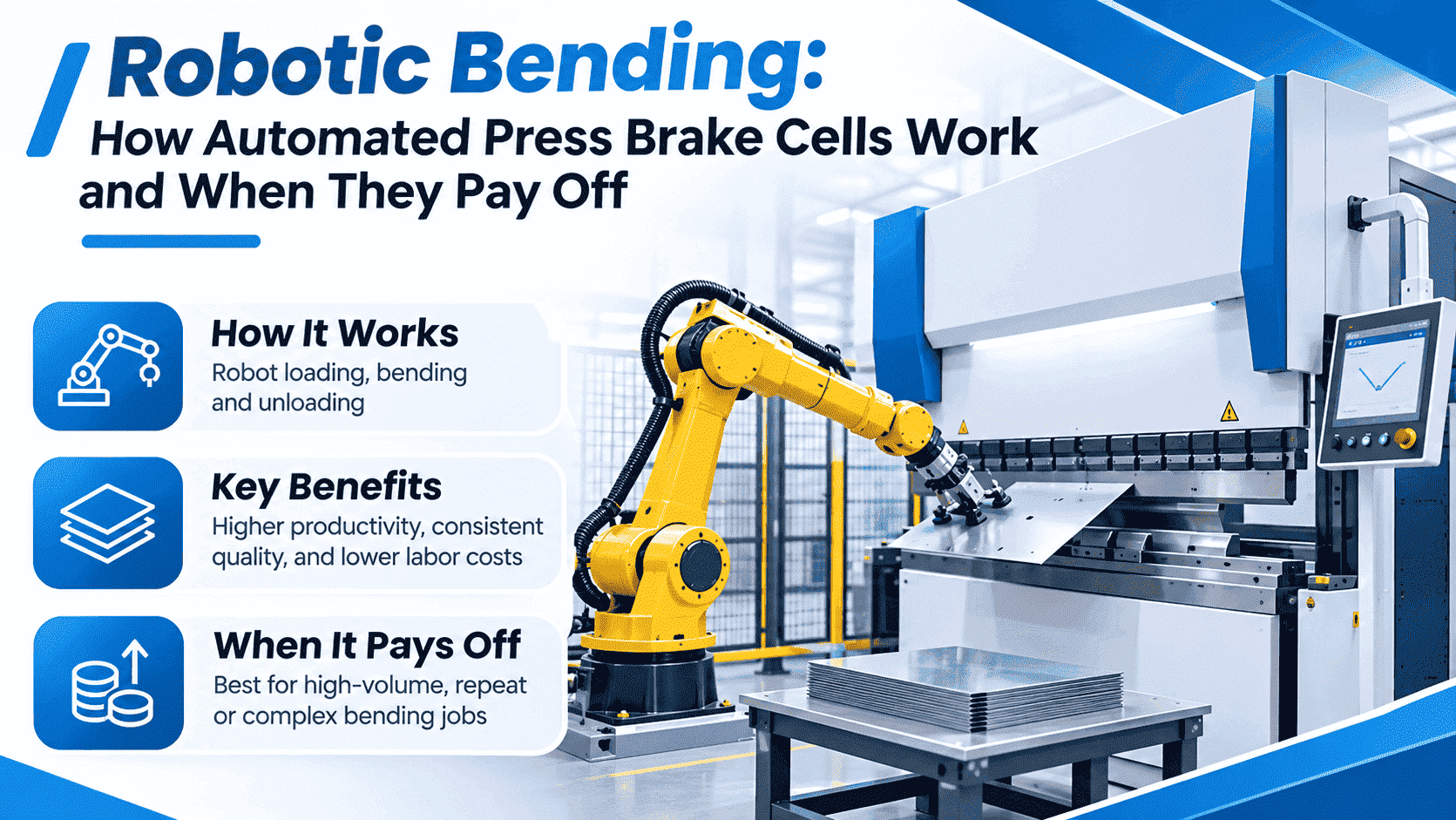
Robotic bending is a sheet metal process in which a robot handles the workpiece while a CNC press brake forms the bends. The robot replaces the operator’s hands. It picks a blank, positions it against the backgauge, holds it through the stroke, and moves it to the next bend or to the output pallet. The press brake still does the forming, so the quality of the finished part depends on both machines and on how well they work together.
A complete robotic bending cell, also called a press brake bending cell, contains five core elements:
| Component | What it does | Why it matters |
|---|---|---|
| CNC press brake | Forms the bends with a punch and die | Sets bend accuracy, tonnage and part size limits |
| Industrial robot | Picks, positions, flips and stacks parts | Sets payload, reach and cycle speed |
| Gripper (end of arm tool) | Holds the sheet with vacuum cups, magnets or clamps | Decides which parts the cell can handle safely |
| Loading and unloading stations | Feed blanks in and stack finished parts | Decides how long the cell can run without an operator |
| Control and programming software | Links robot paths to the bend sequence | Cuts programming time and prevents collisions |
Many cells add an angle measuring system and an automatic tool changer. Those options let the cell correct its own angles and switch between part families without a manual die change.
How a Robotic Bending Cell Works
Every cell follows the same basic cycle, whatever its brand or size:
- Pick the blank. The robot lifts one sheet from a pallet, stack or conveyor with vacuum cups or magnets.
- Check and centre. Sensors confirm that the robot picked a single sheet, and a centring station aligns the blank so every part starts from the same position.
- Position at the press brake. The robot carries the blank to the machine and presses it against the backgauge.
- Bend with sheet following. The press brake closes while the robot follows the rising flange. This movement keeps the part under control and protects the angle and the surface.
- Re-grip, rotate or flip. The robot changes its hold for the next bend. Some cells let the punch and die clamp the part while the gripper re-grips.
- Unload and stack. The robot places the finished part on an output pallet. A measuring system can check the angle before the next part starts.
The robot and the press brake must stay in step through the whole cycle. Poor synchronization during sheet following is a common cause of angle errors and marked surfaces, so cell designers treat it as a core requirement and not as an option.
Sheet Forming Robots: Which Type Fits Your Shop?
Sheet forming robots are the industrial robots and handling systems that tend press brakes and other forming machines. Four layouts dominate bending work, and each one suits a different shop.
| Robot type | Best for | Floor space | Main limit |
|---|---|---|---|
| Floor-mounted 6-axis robot | A dedicated cell on one press brake | Medium | Reach is limited on long press brakes |
| Rail-mounted (track) robot | Long machines, large parts, or one robot serving several machines | Large | Higher cost and a longer installation |
| Overhead gantry robot | Shops with little floor space | Small | Needs a strong frame and enough ceiling height |
| Collaborative robot (cobot) | Light parts and fast redeployment | Small to medium | Lower payload and slower cycle times |
Use three numbers to narrow the choice: the heaviest part, the longest part and the bend length of your CNC press brakes. Add the gripper weight to the part weight before you compare the total against the robot’s payload rating. Parts that need two operators at a manual press brake usually call for a larger robot, and tiny brackets usually call for a smaller, faster one.
Automatic Press Brake vs Robotic Bending Cell
Suppliers use several overlapping labels, such as automatic press brake, robotic press brake and bend cell. The label matters less than the level of automation behind it. Use this table to compare the four common levels.
| Level | What the machine automates | What the operator still does | Best for |
|---|---|---|---|
| CNC press brake | Backgauge and ram positioning, stored bend programs | Loads, holds, flips and unloads every part | Mixed work and small batches |
| Automatic press brake | CNC plus functions such as crowning, angle correction and tool changing | Loads, holds and unloads parts | Shops that change tooling often |
| Robotic bending cell | Automatic press brake plus a robot that handles every part | Loads blanks, removes pallets and watches the cell | Repeat batches and long runs |
| Panel bender (a different machine) | Folds parts with a rotating sheet manipulator and a bending blade | Loads blanks and unloads parts | High volumes of box-shaped parts |
What makes a press brake robot-ready?
A robot can only match the accuracy of the machine it serves. Check these points before you add a robot to any press brake:
- Repeatable positioning. The ram and backgauge must hit the same position cycle after cycle.
- A controller that talks to the robot. The CNC system must exchange start, stop and position signals. Compare the DELEM, CYBELEC, ESA and Syntec options and ask each supplier about robot interfaces.
- Steady, controllable ram speed. Servo-driven machines, such as an all-electric servo CNC press brake or an electro-hydraulic servo CNC press brake, often give the smooth, repeatable motion that sheet following needs.
- Room for the gripper. The open height and throat depth must let the gripper and the part pass through without collisions.
- Optional extras. An automatic tool changer and an angle measuring system extend the range of parts the cell can run unattended.
Benefits of Press Brake Automation
Automation pays back through five practical gains:
- Less dependence on scarce skills. One skilled worker can supervise several cells, because the robot handles the repetitive loading and unloading.
- More productive bending time. The robot reaches the whole bending length without walking, and it keeps a steady cycle time shift after shift.
- Consistent quality. The robot grips and positions every part the same way, so angles and flange lengths vary less between operators and shifts.
- Safer work. The operator stays out of the bending zone. Press brake tending ranks among the riskier machine tending jobs because the worker stands so close to the tool.
- Heavy and large parts without a second person. A robot with the right gripper handles sheets that would otherwise need two operators.
Cells with enough blank storage and output space can also run through breaks and unmanned shifts, which raises machine utilization without extra payroll.
Manual Bending vs Robotic Bending
Robotic bending does not beat manual bending in every case. The table shows where each approach wins.
| Factor | Manual CNC press brake | Robotic bending cell |
|---|---|---|
| Labor per part | High, one or two operators per machine | Low, one operator can watch several cells |
| Setup and changeover | Fast for one-off jobs | Slower, because the robot needs a program and a gripper setup |
| Best batch size | Small and mixed | Medium to large, and repeat orders |
| Quality consistency | Depends on the operator | Stable from part to part |
| Upfront investment | Lower | Higher, because the cell adds a robot, gripper, safety system and software |
| Floor space | One machine footprint | Press brake plus robot, pallets and safety guarding |
| Operator skill | Experienced bending skills | Programming and supervision skills |
| Best use | Prototypes, repairs, custom work | Series production and recurring part families |
Rule of thumb: keep manual bending for flexible, low-volume work, and automate the parts you bend repeatedly. Many shops run both, with one automated press brake for the top part families and manual machines for everything else.
When Does Robotic Bending Pay Off?
Robotic bending pays off when the same parts return often enough to keep the robot busy. Score your own work against this table first.
| Factor | Good fit | Poor fit |
|---|---|---|
| Order pattern | Repeat orders and recurring part families | One-off prototypes and repairs |
| Batch size | Medium to large batches | Single pieces |
| Part size and weight | Within the robot payload and gripper reach | Very large, very flexible or very heavy sheets |
| Bend complexity | Few re-grips and open flanges | Deep boxes that need many re-grips |
| Gripping surface | Flat, clean areas for vacuum cups or magnets | Perforated, oily or very small surfaces |
| Shift pattern | Two or more shifts | One short shift |
How to calculate payback
Use a simple formula, then refine it with your own numbers:
\text{Payback period (years)} = \frac{\text{Total investment}}{\text{Annual net savings}}Annual net savings equal the labor savings plus the margin on extra output, minus the running costs of maintenance, power and programming time.
Illustrative example (hypothetical figures, replace them with yours): a cell costs $160,000 in total. It saves $60,000 a year in labor and adds $30,000 a year in margin from higher output. Running costs take $10,000. Annual net savings reach $80,000, so the payback period is two years.
Supplier case studies commonly cite paybacks of one to three years for typical cells. Your result depends mostly on how many shifts the cell runs and how many different parts you bend repeatedly.
What Drives the Cost of a Robotic Bending Cell?
No single price fits every cell, because each project combines a different press brake, robot and safety layout. These seven factors move the budget the most.
| Cost driver | Why it matters | How to keep it under control |
|---|---|---|
| Press brake tonnage and length | Bigger machines cost more and need bigger robots | Size the machine for your real part range, not your rarest job |
| Robot payload and reach | Heavier payload and longer reach raise the price | Match the robot to the heaviest part plus the gripper |
| Track or gantry | Adds reach and structure | Add it only when bend length or a second machine requires it |
| Grippers and end of arm tooling | Each part family may need its own gripper | Design flexible grippers that cover several parts |
| Tool changer and angle measuring | Adds cost but cuts setup time and scrap | Add them when you run many part families |
| Software and programming | Offline programming needs licenses and training | Choose software that imports 3D CAD files and simulates the cycle |
| Safety and installation | Guarding, scanners, commissioning and training | Plan the layout early and request a fully itemized quote |
Ask every supplier for the same itemized scope. That habit lets you compare real cost of ownership and not just the price of the robot. You can also review our range of bending machines to see which press brake platforms fit your tonnage and length needs.
Programming and Safety in Automated Bending
Offline programming
Offline programming moves the work from the shop floor to the office. The programmer imports a 3D CAD model, and the software calculates the bend sequence, plans the robot path and simulates the full cycle. The simulation exposes collisions and re-grip problems before the first sheet enters the machine. Many modern systems let operators program the cell without deep robot knowledge, which keeps the cell useful for shops that change jobs often.
Safety
A robotic bending cell needs a proper risk assessment before it starts production. Plan for these protections:
- Guarding. Fences with interlocked doors, light curtains or area scanners keep people out of the robot’s reach while it moves.
- Collaborative options. A cobot can work with fewer fences, but it must run at limited speed and force, and it still needs a documented risk assessment.
- Manual access. Some cells let the operator park or power down the robot and bend a rush job by hand.
- Applicable standards. Check the rules in your market, such as ISO 10218 for industrial robots, together with your local press brake safety standard.
Common Challenges in Robotic Bending and How to Fix Them
Automation removes operator variation, but it does not remove bending physics. Plan for these six problems from the start.
| Challenge | Typical cause | Practical fix |
|---|---|---|
| Angle drifts between parts | Springback changes with material batch and thickness | Add angle measuring with automatic correction |
| Part slips in the gripper | Oily, smooth or heavy sheets, or weak vacuum | Combine vacuum cups with magnets or mechanical clamps |
| Sheet flutters during the bend | Weak sheet following on large, thin sheets | Tune the following motion and add supports |
| Too many re-grips | Part geometry or a poor bend sequence | Re-order the sequence in software or clamp the part in the die |
| Gripper hits the tooling | Too little clearance in the open height | Simulate the cycle offline before production |
| Marks on the surface | High grip pressure or dragging across the die | Use softer pads and a controlled following speed |
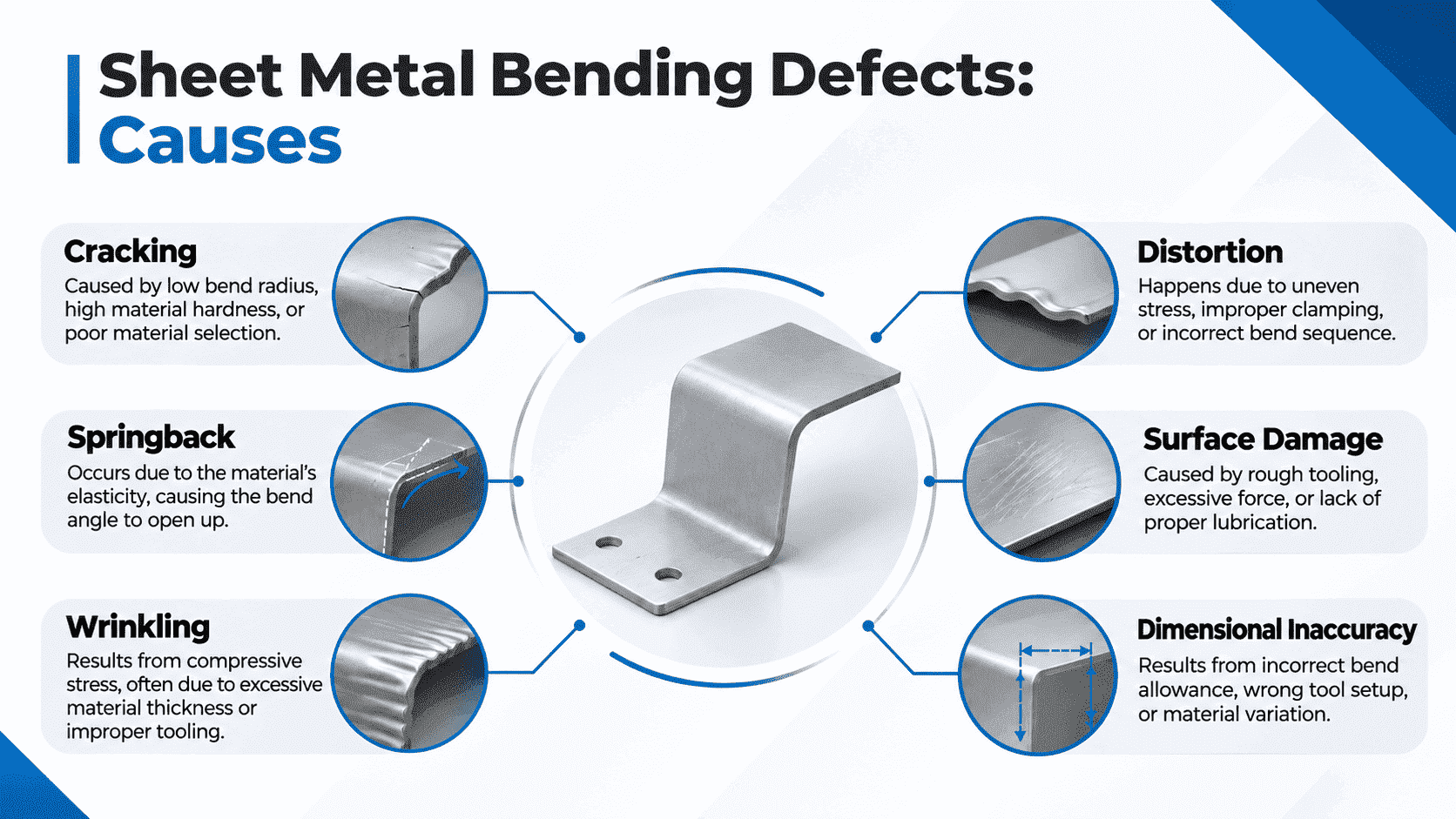
For a deeper look at springback, cracking and angle errors, read our guide to sheet metal bending defects. The same causes and fixes apply whether a person or a robot holds the sheet.
How to Choose the Right Robotic Bending Cell
Follow these seven steps to avoid buying a cell that is too big, too slow or too inflexible.
- Rank your part families. Pull twelve months of orders and sort the parts by volume and repeat rate. The top families decide the business case.
- Define the part envelope. Record the minimum and maximum size, weight, thickness and material for each family.
- Count bends and re-grips. Parts with many re-grips slow the cycle and may need a different gripper or robot.
- Select the press brake first. Choose tonnage, bending length and CNC system for your real parts. Our CNC press brake range shows the available platforms.
- Match the robot and the gripper. Check payload with the gripper included, reach along the full bending length, and the layout that fits your floor.
- Decide on options. Weigh an automatic tool changer, angle measuring, extra loading stations and offline programming against your part mix.
- Test with your own parts. Ask each supplier to bend a sample part, compare total cost of ownership, and confirm service and training support.
Work through the steps in order. A weak answer at step 1 or 2 usually means a lighter form of automation, such as an automatic press brake with sheet supports, makes more sense than a full robotic cell.
From Cutting to Bending: Build One Connected Workflow
A bending cell runs only as fast as it receives blanks. Plan the cutting step and the bending step together, because accurate blanks help the robot centre each part and hold the bend positions.
- Laser-cut blanks. A fiber laser cutting machine produces precise, repeatable blanks for complex outlines. Read our guide to fiber laser cutting cost per hour to budget this step, and our sheet metal cutting guide to match thickness and capacity to your steel plate.
- Sheared blanks. For simple rectangular blanks, a shearing machine can supply the cell at a lower cost.
- Blank handling. Stack blanks on pallets in a fixed order and orientation, so the robot can pick them without extra sorting.
Once cutting and bending share the same data, you can send the same CAD file to both machines and cut the risk of mismatched part versions.
Robotic Bending FAQs
What is robotic bending?
Robotic bending is a sheet metal process in which an industrial robot loads, positions, flips and stacks parts at a CNC press brake. The robot replaces the operator’s handling work, while the press brake forms the bends. Together they make a bending cell that can run with little operator input.
What are sheet forming robots?
Sheet forming robots are industrial robots and handling systems that tend press brakes and other forming machines. They usually carry a vacuum or magnetic gripper and work from a floor, rail, gantry or collaborative mounting.
What is an automatic press brake?
An automatic press brake is a CNC press brake with automated functions such as backgauge positioning, crowning, angle correction or tool changing. It still needs an operator, or a robot, to handle the parts. A robotic bending cell adds that robot.
How does robotic bending differ from a CNC press brake?
A CNC press brake automates the machine, while robotic bending also automates the part handling. The operator on a CNC press brake holds every sheet, whereas a robotic cell moves each sheet with a robot and a gripper.
How much does a robotic bending cell cost?
The price depends on the press brake tonnage and length, the robot payload and reach, the gripper, the software and the safety system. A cell costs more than the press brake alone because it adds all of those items. Ask each supplier for an itemized quote with the same scope.
How long does payback take?
Supplier case studies commonly cite one to three years for typical cells. Your own payback depends on how many shifts the cell runs, how many parts repeat and how much labor it replaces.
Which parts suit robotic bending?
Repeat parts in medium to large batches suit robotic bending best. Parts with few re-grips, flat gripping surfaces and weights within the robot payload run most smoothly.
Can I add a robot to an existing press brake?
Sometimes. The press brake needs accurate positioning, a controller that exchanges signals with a robot, and enough room for the gripper and robot. Ask your supplier to review your machine before you commit.
Should I choose a cobot or an industrial robot?
Choose a cobot for light parts, small floor space and frequent redeployment. Choose an industrial robot for heavier parts, faster cycles and long bending lengths.
Does a robotic cell still need skilled operators?
Yes. Someone must program jobs, load blanks, check part quality and maintain the cell. The skills shift from holding sheets to programming and supervision, and one skilled person can often watch several cells.
Plan Your Robotic Bending Project With Xinli Machinery
Robotic bending delivers the most value when you automate repeat parts on a press brake that is accurate, well controlled and sized for the job. Start with your part data, choose the press brake and CNC system, and then match the robot, gripper and options to that foundation.
Xinli Machinery builds CNC press brakes for sheet metal shops. Browse our bending machines, look at real installations in our factory cases, then contact our team with your part drawings, batch sizes and shift pattern. We will help you choose a press brake and CNC system that fits your automation plan.