
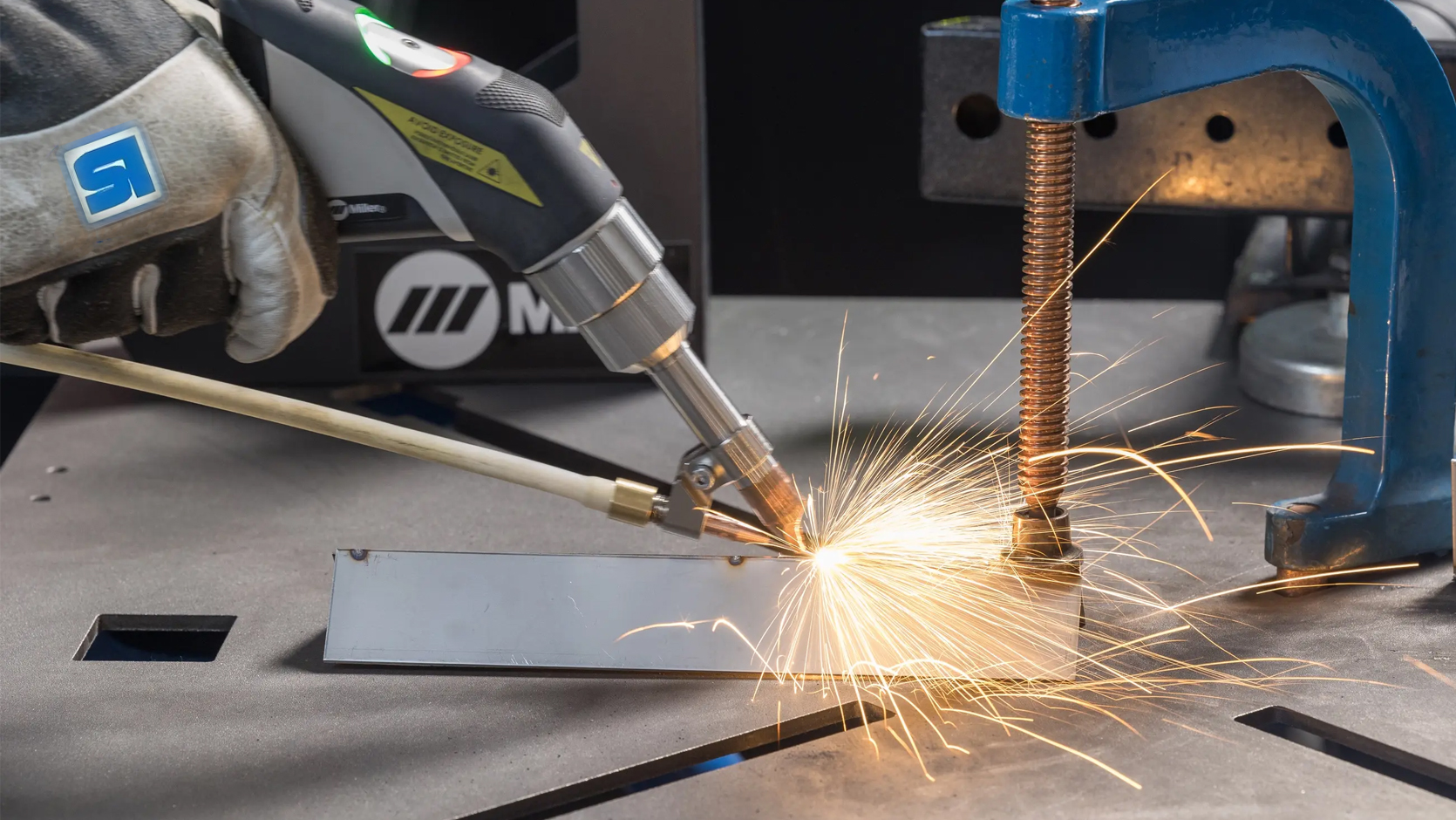
A fiber laser welding machine joins metal by focusing a fiber laser beam onto the joint. The beam melts the edges in a fraction of a second, and they fuse as the weld pool cools. The beam travels from the laser source to the welding head through a flexible optical fiber, so the same technology can be fitted to a hand-held gun, a robot arm or a fixed gantry. Most seam welding in sheet metal shops uses a continuous wave laser welder, which keeps the beam on at steady power for smooth, deep and fast seams.
This guide explains how a fiber laser welding machine works, how continuous wave (CW) and pulsed modes differ, which machine type suits your production volume, which settings control weld quality and how to fix common defects. If you already know you want a portable gun, our handheld laser welding machine guide covers specs, power levels and buying details. This article looks at the technology behind every fiber laser welder.
Key Takeaways
- A fiber laser welding machine uses a solid-state laser source at about 1070 nm, delivered through an optical fiber to the welding head.
- A continuous wave laser welder is the standard choice for seams on sheet and plate. Pulsed (QCW) machines suit small, heat-sensitive spot and micro welds.
- A handheld laser welder suits mixed parts and low to medium volume. Robotic and gantry systems suit repeatable, high-volume work.
- Weld quality depends on power, travel speed, focus, shielding gas and joint fit-up together, not on laser power alone.
- Accurate cutting and bending upstream make laser welding easier, because tight joints weld cleanly.
What Is a Fiber Laser Welding Machine?
A fiber laser welding machine is a metal joining system built around a fiber laser source. Inside the source, diode modules pump light into a doped optical fiber (usually ytterbium), which amplifies it into a high-power beam at roughly 1070 nm. The beam leaves through a delivery fiber, and a welding head collimates and focuses it onto the workpiece.
Three features explain why this design replaced older laser welders in most workshops:
- Flexible beam delivery. A fiber cable carries the beam, so there are no mirrors to align. This is what makes hand-held and robot-mounted heads possible.
- High electrical efficiency. Fiber sources typically convert far more electricity into light than CO2 sources, so running costs and cooling load are lower.
- Good absorption in metals. Metals absorb light near 1 micrometer much better than the 10.6 micrometer light of a CO2 laser, so welding starts quickly and efficiently.
A complete machine also needs a water chiller, a shielding gas supply, a control system and a motion method (a hand, a robot or a gantry). Xinli builds the cutting side of this line too, with the fiber laser cutting machine from the same laser family.
How Fiber Laser Welding Works
The process follows the same sequence on every fiber laser welder:
- Pump diodes feed light into the doped fiber, which amplifies it into the working beam.
- The delivery fiber carries the beam to the welding head.
- Optics in the head focus the beam to a small spot on the joint.
- The metal absorbs the energy and melts. At high power density, the surface vaporizes slightly and forms a narrow vapor channel called a keyhole.
- The keyhole lets the beam reach deep into the joint, and the molten metal flows around it.
- Shielding gas protects the pool from oxygen while it solidifies into the weld bead.
Welds form in one of two modes, and the mode explains why laser welds are narrow and deep:
| Feature | Conduction mode | Keyhole mode |
|---|---|---|
| Power density | Lower | High, on the order of 1 MW per cm2 |
| How the joint melts | Heat spreads from the surface by conduction | Beam enters a vapor channel and heats the full depth |
| Weld shape | Wide and shallow | Narrow and deep |
| Typical use | Thin sheet, cosmetic seams, wobble welds | Deeper penetration, structural joints |
| Main risk | Limited penetration | Porosity or spatter if unstable |
Because the heat input is concentrated, the heat-affected zone stays small. That means less distortion and less discoloration than arc welding on thin material.
Continuous Wave Laser Welder vs Pulsed (QCW) Fiber Laser Welder
A continuous wave laser welder emits a steady beam for as long as the trigger is on. A pulsed or quasi-continuous wave (QCW) laser delivers short bursts with a high peak power and a low average power. Both use fiber technology, but they serve different jobs.
| Factor | Continuous wave (CW) | Pulsed or QCW |
|---|---|---|
| Beam output | Steady, constant power | Short pulses with high peak power |
| Seam formation | One continuous melt pool | Overlapping spots form a seam |
| Weld speed | High | Lower for long seams |
| Heat input | Steady, controlled with speed and wobble | Low average heat, very localized |
| Best for | Long seams on sheet and plate, enclosures, tanks, frames | Micro welding, thin foils, spot welds, heat-sensitive parts |
| Typical industries | Sheet metal, stainless products, equipment manufacturing | Electronics, medical parts, battery components |
| Limit | Can overheat very thin or delicate parts | Slow on long seams |
For sheet metal fabrication, a CW fiber laser with a wobble head is the usual answer. The beam oscillates across the seam, which widens the weld and helps bridge small gaps. If your work is mostly tiny spot joints on thin foils, ask the supplier about a pulsed source instead.
Fiber Laser vs CO2, Nd:YAG and Diode Laser Welding
Fiber lasers are now the default for new welding machines, but you may still meet other laser types in used equipment or quotations.
| Factor | Fiber laser | CO2 laser | Nd:YAG laser | Direct diode laser |
|---|---|---|---|---|
| Wavelength | About 1070 nm | About 10,600 nm | About 1064 nm | About 800 to 980 nm |
| Beam delivery | Flexible fiber | Mirrors, fixed path | Fiber | Fiber |
| Absorption in metals | Good | Lower | Good | Good, with a larger spot |
| Electrical efficiency | High | Low | Low (lamp pumped) | High |
| Maintenance | Low, no mirrors to align | Higher, gas and mirrors | Higher, lamps and rods | Low |
| Hand-held use | Yes | No | Limited | Rare |
| Typical role today | General welding and cutting | Non-metals and some thick-plate work | Older pulsed spot welding | Cladding, soldering, wide-spot welding |
The practical conclusion is simple: for metal seam welding with a hand-held or robotic head, a fiber source gives the best mix of flexibility, efficiency and upkeep.
Types of Fiber Laser Welding Machines
The laser source is similar across machines. What changes is how the beam is moved, and that decides cost, speed and repeatability.
| Machine type | How it works | Best for | Volume | Main requirement |
|---|---|---|---|---|
| Handheld laser welder | Operator guides the gun along the seam | Mixed parts, long seams, large frames, repairs | Low to medium | Trained operator and laser safety area |
| Robotic laser welding cell | Robot arm moves the head along a programmed path | Repeatable parts in series | Medium to high | Accurate fixtures and consistent parts |
| Gantry or bench machine | Head moves on an XYZ frame over a fixed table | Flat or box-shaped parts | Medium | Programmed paths and clamping |
| Galvo scanner head | Mirrors steer the beam at high speed | Short welds, spot patterns, fast cycles | High | Stable part position |
A handheld laser welder has the lowest entry cost and no programming, which is why small and mid-size fabrication shops adopt it first. Automated cells make sense when the same part runs in volume and you need identical welds every cycle. Xinli currently supplies the handheld laser welding machine for welding. If your volume calls for an automated cell, contact our engineers to discuss your parts.
Key Fiber Laser Welding Parameters
Good welds come from balancing several settings at once. Use this table to understand what each one does and what goes wrong at the extremes.
| Parameter | What it controls | If too high | If too low |
|---|---|---|---|
| Laser power | Energy and penetration depth | Burn-through, spatter, wide HAZ | Lack of fusion, shallow weld |
| Travel speed | Heat input per length | Narrow, weak or incomplete weld | Overheating, distortion, sagging |
| Focus position | Power density at the surface | Unstable keyhole when far off | Weak penetration when defocused too much |
| Wobble width and frequency | Seam width and gap tolerance | Wide, shallow seam, lower depth | Narrow seam, little gap bridging |
| Shielding gas flow | Oxidation protection | Disturbed melt pool | Dark, oxidized, porous weld |
| Wire feed speed | Added filler volume | Excess reinforcement, poor appearance | Underfill, undercut |
Best practice is to change one setting at a time on scrap material and record the result. Many machines store presets by material and thickness, so a proven set can be reused by any operator.
Joint Design and Fit-Up for Laser Welding
The beam is small, so joint fit-up matters more than it does with arc welding. As a rule of thumb, keep the gap under about 10 percent of the thinner sheet when welding without filler wire. Wobble and filler wire extend that tolerance, but they do not replace accurate parts.
| Joint type | Description | Notes for laser welding |
|---|---|---|
| Butt joint | Two edges placed side by side | Needs tight edges and straight cuts; laser-cut edges work well |
| Lap joint | One sheet overlaps another | Weld through the top sheet; control the gap between sheets |
| Corner or edge joint | Two sheets meet at a right angle | Common on enclosures; fast with a handheld laser welder |
| T or fillet joint | One part stands on another | Aim the beam at the root; a wobble head helps fill |
Clean edges and surfaces also help. Remove oil, rust and paint before welding, because contamination causes porosity and spatter.
Materials and How the Beam Behaves
A fiber laser can weld most structural metals. The challenge is how each metal absorbs and conducts the heat.
| Material | Behavior at 1070 nm | Main challenge | Practical tip |
|---|---|---|---|
| Stainless steel (304, 316) | Absorbs well, low conductivity | Discoloration if shielding is poor | Use correct gas flow and clean joints |
| Carbon steel | Absorbs well | Oil, rust and scale cause defects | Clean the joint; manage fast cooling on thick parts |
| Galvanized steel | Absorbs well | Zinc vaporizes below the melting point of steel | Use fume extraction; a tiny lap gap lets vapor escape |
| Aluminum | Reflective, conducts heat fast | Oxide layer, porosity, hot cracking in some alloys | Use higher power, clean oxide, choose a suitable filler wire |
| Copper and brass | Highly reflective | Unstable coupling at the start | Use higher power and test welds first |
| Titanium | Absorbs well | Oxidizes and turns brittle when hot | Shield the front, back and trailing side with inert gas |
| Dissimilar metals | Varies | Brittle intermetallic phases | Test the pairing; filler wire or interlayers may be needed |
For exact power-to-thickness figures on stainless steel, carbon steel and aluminum, see the table in our handheld laser welding machine guide.
Common Fiber Laser Welding Defects and Fixes
| Defect | Likely cause | First fix |
|---|---|---|
| Porosity | Contamination, low gas coverage, unstable keyhole | Clean the joint, check gas flow and nozzle, adjust speed |
| Undercut | Speed too high, too little filler | Slow down slightly or add filler wire |
| Spatter | Excess power, dirty material, wrong focus | Reduce power or adjust focus; clean the surface |
| Lack of fusion | Power too low, speed too high, gap too wide | Raise power, slow down, improve fit-up |
| Burn-through | Too much heat for the thickness | Lower power or increase travel speed |
| Hot cracking | Crack-sensitive alloy, high restraint | Use a suitable filler wire and adjust the joint |
| Discoloration | Oxygen reaching the hot metal | Increase shielding gas coverage and check the nozzle |
Keep the protective lens in the welding head clean. Spatter on the lens absorbs power and causes unstable welds long before the machine shows a fault.
How to Choose a Fiber Laser Welding Machine
Work through these steps in order:
- List your materials and thickness range. Use the thickest common part, with extra margin for aluminum and reflective metals.
- Pick the laser mode. Choose a continuous wave laser welder for seams. Ask about pulsed output only for micro or spot work.
- Match the machine type to your volume. Use a handheld laser welder for variety and low to medium output. Move to robotic or gantry systems when parts repeat in volume.
- Check your upstream accuracy. Laser welding needs tight joints, so confirm that your cutting and bending produce consistent parts.
- Ask for a test weld on your own sample. Judge seam appearance, penetration and speed on your material before you buy.
When you request a quotation, ask which laser source and chiller are fitted, what warranty applies and what operator training is included. For running costs, the electricity, gas and consumable logic in our guide to fiber laser cutting cost per hour applies to welding too.
Fiber Laser Welding in a Cutting, Bending and Welding Line
Most sheet metal shops run three steps: cut, bend, weld. Each step sets up the next one.
- Cut: a fiber laser cutting machine produces accurate blanks. See our guide to sheet metal cutting thickness and capacity to match power to material.
- Bend: a CNC press brake forms the parts. Good bending practice keeps flanges square so joints close properly. Read about minimum flange length, bending sequence planning and press brake tonnage calculation.
- Weld: a fiber laser welder joins the formed parts with little distortion. For stainless parts, see press brake bending stainless steel before welding.
For straight cuts on heavier plate, compare guillotine and swing beam shears or browse our shearing machines. You can also see how this equipment runs in real workshops on our Factory Cases page.
Maintenance and Safety Essentials
A fiber laser welder needs less upkeep than older laser types, but a few habits protect weld quality:
- Inspect and replace the protective lens on a routine basis.
- Keep the chiller water clean and the filters clear.
- Keep the fiber connector and head optics free of dust and handle them only with proper tools.
- Treat the machine as a Class 4 laser: use laser safety eyewear rated for the wavelength, a controlled work area and fume extraction.
The full routine for optics, chillers and gas is in our laser machine maintenance guide.
Xinli Fiber Laser Welding Solutions
Xinli Machinery has built metal forming equipment since 1958 and ships to more than 90 countries. Our handheld laser welding machine is a fiber laser welder with 1000W, 1500W and 2000W options, water cooling and a rated welding thickness of up to 5 mm depending on the material. It is backed by a 24-month warranty and after-sales support. Learn more about Xinli, or explore the full laser cutting and welding range and our CNC systems for press brakes.
Ready to test a weld on your parts? Request a quote with your material, thickness and drawing, and our engineers will recommend a power level and configuration.
Fiber Laser Welding Machine FAQs
What is a fiber laser welding machine?
A fiber laser welding machine is a metal joining system that uses a fiber laser source at about 1070 nm. The beam travels through an optical fiber to a welding head, which focuses it on the joint to melt and fuse the metal. It can be hand-held, robot-mounted or gantry-mounted.
What is a continuous wave laser welder?
A continuous wave laser welder emits a steady, uninterrupted laser beam while the trigger is on. This produces one continuous melt pool, which suits long seams on sheet and plate. It is the most common mode for fabrication and sheet metal welding.
What is the difference between CW and pulsed fiber laser welding?
CW welding keeps the beam on at constant power and is faster for long seams. Pulsed or QCW welding sends short, high-peak-power bursts and adds very little average heat. Pulsed output suits micro welding, thin foils and heat-sensitive parts.
What is a handheld laser welder and when should I use one?
A handheld laser welder is a fiber laser welding machine with a hand-held gun that the operator moves along the joint. Use it for mixed parts, long seams, large frames and repairs, where building a fixture for every part is not practical. See our handheld laser welding machine guide for specifications.
Is a fiber laser better than a CO2 laser for welding metal?
For most metal welding, yes. A fiber laser is absorbed better by metals, delivers its beam through a flexible fiber, uses electricity more efficiently and needs less maintenance. CO2 lasers are still used for some non-metal work and specific thick-plate applications.
What metals can a fiber laser welding machine weld?
It can weld stainless steel, carbon steel, galvanized steel, aluminum and titanium. Reflective metals such as copper and brass are harder and need more power and testing. Dissimilar metal pairs need trials because they can form brittle phases.
Does fiber laser welding need shielding gas?
Yes, in most cases. Argon or nitrogen protects the weld pool from oxygen, keeps stainless seams bright and reduces porosity. Titanium needs extra inert gas coverage on the back and trailing side of the weld.
How do I choose the right laser power?
Pick the power that covers your thickest common part, then add margin for aluminum and reflective metals. Higher power also allows faster travel speed. Always confirm with a test weld on your own sample before ordering.
Is fiber laser welding strong enough for structural parts?
A well-made laser weld has deep penetration and a narrow heat-affected zone, so it can be very strong on thin and medium sheet. Strength depends on fit-up, penetration and process control. For heavy structural plate, arc welding or a higher-power system may still be the better choice.
How long does a fiber laser source last?
Fiber laser sources are often rated for tens of thousands of operating hours, and many suppliers quote figures around 100,000 hours. Real life depends on duty cycle, cooling and cleanliness. Ask the supplier for the rated life of the specific source fitted to your machine.
Is a fiber laser welding machine safe to operate?
It is safe with the right controls. The laser is Class 4, so operators need laser safety eyewear, a defined work area, fume extraction and training. Follow the manufacturer’s instructions and your local laser safety rules.
Conclusion
A fiber laser welding machine gives fabricators fast, clean and low-distortion welds, as long as the process is matched to the job. Choose a continuous wave laser welder for seams, use a handheld laser welder for flexibility, move to automation when parts repeat in volume, and keep joint fit-up tight. To discuss your material and thickness, contact Xinli or read more practical guides in our News section.