Choosing the right cutting process for sheet metal depends on more than the material’s dimensions. Thickness, metal composition, required edge quality and production volume all influence the final result. A machine that cuts thin stainless steel efficiently may not deliver the same performance when processing thick carbon steel or aluminum plates.
Understanding sheet metal cutting thickness and machine capacity helps manufacturers select suitable equipment, reduce material waste and maintain consistent production quality. It also helps production managers determine whether their existing machinery can handle new projects or whether a higher-capacity cutting solution is required.
This guide explains how sheet metal thickness affects cutting performance, what determines metal cutting capacity, and how to evaluate steel plate cutting requirements for different industrial applications.
What Is Sheet Metal Cutting?
Sheet metal cutting is a manufacturing process used to separate metal sheets or plates into specific shapes and dimensions. It involves removing material along a defined cutting line while maintaining the required measurements and edge quality.
Manufacturers use different cutting methods depending on material thickness, production requirements, accuracy and the type of finished component.
Common sheet metal cutting methods include:
Fiber laser cutting: Uses a concentrated laser beam to cut metal with high precision and relatively narrow kerfs.
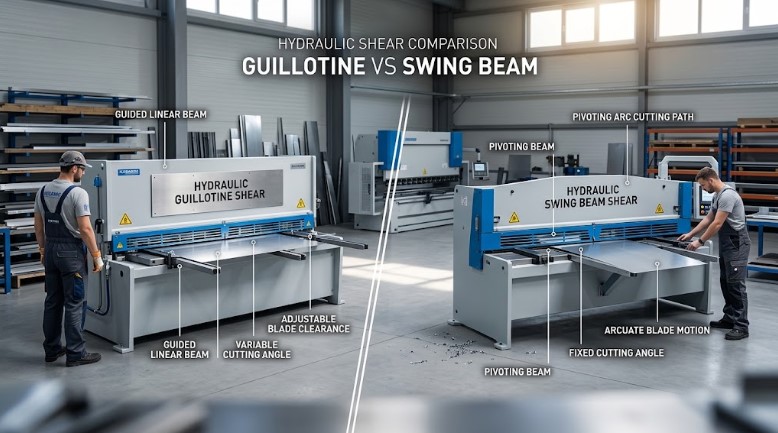
Mechanical shearing: Uses upper and lower blades to make straight cuts through sheet metal.
Plasma cutting: Uses an electrically conductive, high-temperature plasma arc to cut electrically conductive metals.
Waterjet cutting: Uses a high-pressure water stream, often combined with abrasive material, to cut different materials without introducing a significant heat-affected zone.
Each method has different operating characteristics. Fiber laser cutting is suitable for detailed profiles and complex shapes, while mechanical shearing is commonly used for straight cuts in sheet and plate materials.
The appropriate process depends on the required cutting thickness, production speed, dimensional tolerances and overall manufacturing needs.
Understanding Sheet Metal Cutting Thickness
Sheet metal cutting thickness refers to the depth of metal that a cutting machine or process can successfully separate. It is commonly measured in millimetres (mm), although inches are also used in some markets.
Thickness is an important factor because it affects cutting speed, equipment requirements, edge quality and operating costs.
For example, cutting a 1 mm stainless steel sheet requires different machine settings from cutting a 12 mm carbon steel plate. Even when the same cutting technology is used, the power, speed, assist gas and other process parameters may need adjustment.
Common Sheet Metal Thickness Measurements
The following table provides examples of commonly encountered sheet and plate thicknesses in industrial fabrication.
| Thickness (mm) | Typical Material Applications |
|---|---|
| 0.5–1 mm | Electrical enclosures, appliance panels and lightweight components |
| 1–2 mm | Cabinets, ventilation ducts and automotive panels |
| 2–3 mm | Machinery covers, equipment housings and brackets |
| 3–5 mm | Industrial frames, structural components and machine parts |
| 5–8 mm | Heavy equipment components and metal structures |
| 8–12 mm | Industrial plates, machinery components and structural fabrication |
| 12–20 mm | Heavy-duty steel components and engineering applications |
| Above 20 mm | Thick plate fabrication and specialised industrial cutting |
These are application examples, not guaranteed machine cutting limits. Actual cutting capability depends on the material, cutting technology, machine configuration and manufacturer specifications.
How Does Thickness Affect Cutting Performance?
Increasing material thickness changes the requirements of the cutting process.
Cutting Speed: Thicker materials generally require slower cutting speeds, particularly when using thermal cutting technologies. The machine needs sufficient energy and suitable parameters to complete the cut.
Edge Quality: Incorrect settings can produce rough edges, excessive dross, burrs or dimensional inaccuracies. Proper adjustment becomes increasingly important when processing thicker materials.
Machine Power: Laser cutting systems require suitable laser output for the material and thickness being processed. Higher power may expand the available cutting range, but power alone does not guarantee good results.
Production Efficiency: Cutting thicker plates may increase processing time and operating costs. Manufacturers should consider the balance between cutting speed, quality and overall production requirements.
Metal Cutting Capacity: What Determines a Machine’s Cutting Limits?
Metal cutting capacity describes the maximum material thickness and dimensions that a machine can process under specified operating conditions.
However, there is no single capacity figure that applies to every metal cutting machine. Different materials respond differently to the same cutting process.
Several factors determine the actual metal cutting capacity.
1. Material Type and Composition
The material being processed has a direct influence on cutting performance.
Carbon steel, stainless steel and aluminum have different thermal and physical properties. As a result, a machine may handle different maximum thicknesses for each material.
For example, stainless steel and carbon steel may require different laser cutting parameters, while reflective materials such as aluminum can introduce additional considerations for laser systems.
2. Laser Power and Cutting Technology
For fiber laser cutting, laser power is an important factor in determining the available cutting range.
Higher laser power can support the processing of thicker materials, but the final result also depends on beam quality, focus position, cutting head configuration, assist gas and machine stability.
Mechanical shearing operates differently. Its capacity is influenced by blade strength, machine design, cutting length and the strength of the material.
3. Assist Gas and Cutting Parameters
In laser cutting, assist gas helps remove molten material from the cutting area.
Common options include:
Oxygen for certain carbon steel cutting applications.
Nitrogen for applications requiring cleaner edges and reduced oxidation.
Compressed air for selected cutting operations where suitable.
Gas pressure, nozzle selection, focus position and cutting speed must be matched to the material and thickness.
4. Machine Stability and Structural Design
A machine’s mechanical structure also affects cutting consistency.
A stable machine frame, accurate motion system and reliable CNC control help maintain positioning accuracy throughout the cutting process.
For industrial applications, manufacturers should evaluate the complete machine configuration rather than selecting equipment based only on its advertised power rating.
Steel Plate Cutting Thickness: How to Choose the Right Capacity
Steel plate cutting thickness is an important consideration for manufacturers working with structural steel, machinery components, construction materials and heavy industrial products.
The required capacity should be based on the thickest material regularly processed, not simply the average thickness used in production.
For example, a fabrication workshop that mainly cuts 3–6 mm steel but occasionally handles 15 mm plates should evaluate whether its equipment can accommodate both production requirements without compromising quality or efficiency.
Steel Plate Thickness and Cutting Considerations
| Steel Plate Thickness | Key Cutting Considerations |
|---|---|
| 1–3 mm | High cutting speed, dimensional accuracy and heat management |
| 3–6 mm | Consistent cutting speed and edge quality |
| 6–10 mm | Appropriate power, gas selection and process stability |
| 10–15 mm | Cutting parameters, material grade and edge requirements |
| 15–20 mm | Machine capacity, processing time and thermal effects |
| Above 20 mm | Specialized equipment configuration and verified cutting specifications |
This table is intended as a production-planning reference rather than a universal machine specification. The actual limits must be confirmed against the selected machine’s technical documentation.
Carbon Steel vs Stainless Steel vs Aluminum
Different materials require different cutting conditions, even when their thicknesses are similar.
| Material | Important Cutting Factors | Common Applications |
|---|---|---|
| Carbon Steel | Material grade, thickness, oxygen or nitrogen selection | Structural parts, machinery and frames |
| Stainless Steel | Heat input, oxidation control and edge finish | Food equipment, enclosures and industrial components |
| Aluminium | Reflectivity, thermal conductivity and process settings | Automotive parts, panels and lightweight structures |
| Mild Steel | Thickness, cutting speed and assist gas | General fabrication and construction |
Manufacturers should always test cutting parameters using the actual material grade and thickness required for production.
Fiber Laser Cutting vs Mechanical Shearing: Which Is Better?
Selecting between fiber laser cutting and mechanical shearing depends on the type of components being manufactured.
Both methods are widely used in sheet metal processing, but they serve different production requirements.
| Comparison Factor | Fiber Laser Cutting | Mechanical Shearing |
|---|---|---|
| Cutting Style | Complex shapes and profiles | Straight-line cuts |
| Design Flexibility | Suitable for intricate designs | Limited to straight cutting operations |
| Edge Quality | Precise cuts with narrow kerf | Clean straight edges with correctly adjusted blades |
| Material Processing | Various compatible metal materials | Sheet and plate materials within machine capacity |
| Tooling | Laser cutting head and associated components | Upper and lower cutting blades |
| Best Applications | Detailed components and customised parts | Sheet preparation and repetitive straight cuts |
When to choose fiber laser cutting: It is suitable when production involves complex shapes, detailed profiles, narrow cutting paths and flexible design requirements.
When to choose mechanical shearing: It is suitable when production mainly involves straight cuts, sheet preparation and repetitive cutting operations.
Xinli Machinery offers industrial metal processing solutions, including fiber laser cutting machines and shearing machines, for different fabrication requirements.
How to Calculate the Right Metal Cutting Capacity
Selecting machine capacity becomes easier when manufacturers understand their regular production requirements.
Rather than choosing equipment based on the highest available cutting thickness, businesses should evaluate their material range, production volume and finished component specifications.
Consider the following steps.
Step 1: Identify Your Maximum Material Thickness
List the thicknesses your production facility regularly processes.
For example:
2 mm stainless steel
4 mm carbon steel
6 mm mild steel
10 mm carbon steel plates
Identify the thickest material that needs to be processed consistently.
Step 2: Confirm the Material Grades
Different grades of the same metal may behave differently during cutting.
Record the material specifications, including carbon steel grade, stainless steel grade or aluminium alloy.
This information helps determine suitable cutting parameters and machine configuration.
Step 3: Evaluate Production Volume
A machine that can cut a particular thickness once may not be the most efficient choice for continuous industrial production at that thickness.
Consider:
Daily cutting requirements.
Number of production shifts.
Average cutting length.
Required processing speed.
Expected machine operating hours.
Step 4: Consider Future Production Requirements
Manufacturers should also consider whether their product range may expand.
If a business expects to process thicker steel plates or introduce new metal components, selecting an appropriately configured machine can reduce the need for an early equipment upgrade.
Step 5: Confirm the Manufacturer’s Specifications
Before purchasing equipment, request technical information covering:
Maximum cutting thickness by material.
Recommended production thickness.
Cutting speed at different thicknesses.
Laser power or mechanical cutting capacity.
Working area and processing dimensions.
Required electrical and gas configurations.
The recommended production range is particularly important because maximum cutting capacity does not always represent the most efficient continuous operating range.
Common Mistakes When Selecting Sheet Metal Cutting Equipment
Choosing the wrong cutting equipment can increase production costs and create unnecessary operational problems.
Here are some common mistakes manufacturers should avoid.
Choosing a Machine Based Only on Maximum Thickness
Maximum cutting thickness is not necessarily the best indicator of everyday performance. Check the recommended production thickness and cutting speed as well.
Ignoring Material Differences
A machine’s cutting performance can vary between carbon steel, stainless steel and aluminium. Always check material-specific specifications.
Overlooking Edge Quality
Some projects require minimal burrs, clean edges and precise dimensions. Equipment should be selected according to the finished component’s quality requirements.
Not Considering Production Volume
Occasional cutting and continuous high-volume production have different requirements. Evaluate duty cycle, processing speed and machine stability.
Ignoring Future Requirements
Selecting equipment that only meets current production needs may limit business growth. Consider expected material thicknesses and new product requirements before making a purchase.
How Xinli Machinery Supports Industrial Metal Cutting Requirements
Xinli Machinery (Suzhou) Co., Ltd. provides industrial metal processing equipment for manufacturers working across different fabrication applications.
Its product range includes fiber laser cutting systems, shearing machines and metal-forming equipment designed for industrial production environments.
The company’s fiber laser cutting machine is designed for precision metal processing, with example configurations ranging from 1,000W to 6,000W laser power. Actual cutting thickness depends on material type, machine configuration and operating parameters.
For manufacturers processing sheet metal before forming operations, Xinli also provides different shearing machine solutions.
The company has a manufacturing history dating back to 1958 and serves customers across more than 90 exporting countries. Its equipment solutions support applications in automotive manufacturing, construction, energy and industrial fabrication.
Businesses evaluating their next cutting solution can discuss their material specifications, production requirements and desired machine configuration directly with the Xinli Machinery team.
Frequently Asked Questions About Sheet Metal Cutting
1. What is the maximum thickness for sheet metal cutting?
There is no universal maximum thickness for sheet metal cutting. It depends on the cutting method, machine configuration, material type and available power. Fiber laser systems, plasma cutters and mechanical shears all have different capacity limits.
2. How thick of a metal sheet can a laser cutting machine cut?
A laser cutting machine’s maximum thickness depends on its laser power, material and cutting configuration. Higher-powered fiber laser systems can process thicker materials, but the manufacturer’s material-specific cutting chart should always be checked.
3. What is sheet metal cutting thickness?
Sheet metal cutting thickness is the measurement of how thick a metal sheet or plate is when processed by a cutting machine. It is generally measured in millimetres (mm) and influences cutting speed, power requirements and edge quality.
4. What factors affect metal cutting capacity?
Metal cutting capacity depends on material composition, thickness, machine power, cutting technology, equipment stability and operating parameters. For laser cutting, assist gas, nozzle selection and focus position also influence performance.
5. What is the best machine for cutting thick steel plates?
The best machine depends on the required steel thickness, production volume and edge quality. High-power fiber laser systems and industrial plasma cutting equipment are common options, while heavy-duty mechanical shears are suitable for straight cuts within their rated capacity.
6. Can a fiber laser cutting machine cut stainless steel?
Yes. Fiber laser cutting machines can process stainless steel when the laser power, material thickness, assist gas and cutting parameters are suitable. Nitrogen is commonly used where reduced oxidation and a cleaner edge are required.
7. What is the difference between sheet metal cutting and steel plate cutting?
Sheet metal cutting generally refers to processing thinner metal sheets into required shapes and dimensions. Steel plate cutting often involves thicker and heavier material used in structural fabrication, machinery and industrial components. The distinction can vary by industry.
8. Does higher laser power always mean better cutting quality?
No. Higher laser power can increase the available cutting range, but quality also depends on beam characteristics, cutting speed, focus position, assist gas and material properties. Correctly matched parameters are essential for consistent results.
9. How do I choose the right sheet metal cutting machine?
Start by identifying your material types, maximum thickness, required cutting dimensions, production volume and edge quality requirements. Then compare machine specifications and request material-specific cutting tests or performance data before purchasing.
10. How can manufacturers improve sheet metal cutting efficiency?
Manufacturers can improve efficiency by selecting suitable machine capacity, optimising cutting parameters, maintaining cutting components, choosing appropriate assist gases and organising material handling processes. Regular equipment maintenance also helps maintain consistent production performance.