Quick answer: Choosing a hydraulic guillotine shear vs swing beam shear starts with understanding how the upper blade moves and which adjustments are available. Both machines cut sheet between a moving upper blade and a fixed lower blade, but their blade-carrier motion and configuration differ. A guillotine design guides the beam along a mainly straight path; a swing-beam design pivots the beam through an arc. Neither type is automatically more accurate or productive for every job. Compare the exact machine’s rated material and thickness, cut length, blade clearance and angle controls, backgauge, support options, duty cycle, safety package, service access, and first-piece results.
This guide explains how to make that comparison for a real fabrication workflow. Product names and configurations vary by manufacturer, so confirm every specification in the model-specific manual and quotation before buying, setting up, or operating a shear.
Hydraulic guillotine shear vs swing beam shear: the core difference
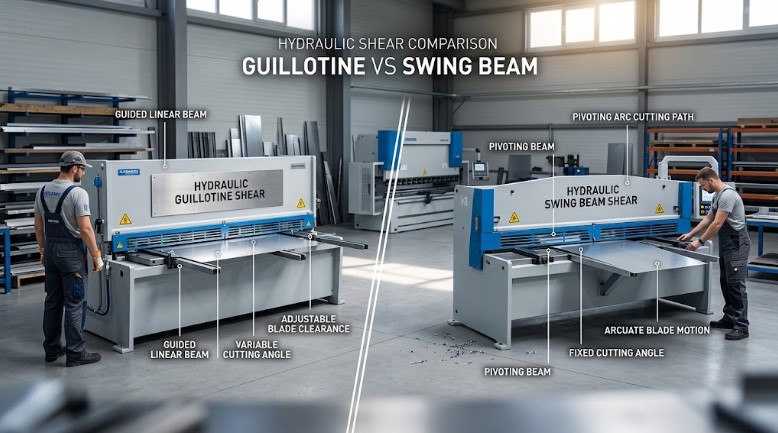
In a guillotine shear, the upper beam is constrained by guides as it travels toward the lower blade. The machine may use a fixed or adjustable cutting angle and may provide manual, motorized, or CNC blade-gap adjustment depending on its design. Some hydraulic guillotine models also offer independent hold-downs, programmable backgauges, and sheet supports. These are configuration choices, not features that can be assumed from the word “guillotine.”
In a swing-beam shear, the upper beam pivots around a designed axis while the blade passes the lower blade. The cutting geometry therefore changes through an arc. Many swing-beam designs use a fixed cutting angle and rely on a manufacturer-defined blade geometry and clearance procedure; some models include adjustment features. Do not generalize from one brand to another: check the manual and the actual quotation.
The practical buying question is not which label sounds better. It is whether the exact machine can cut the shop’s materials, thickness range, width, tolerances, volumes, and shapes with an acceptable operating cost and a safe, repeatable process.
How the blade motion affects the cut
A shear cuts by forcing the sheet between two blades with a controlled gap. Blade geometry, overlap, cutting angle, material properties, thickness, support, hold-down action, and machine condition all influence the result. The cut edge commonly has a rollover or entry zone, a burnished or sheared zone, a fracture zone, and a burr. Their appearance depends on the full process; the machine type alone does not predict edge quality.
On a guillotine machine, guided motion and a variable cutting angle can be available on some configurations. A smaller angle can reduce the instantaneous length of material engaged by the blade, but a larger angle can increase sheet distortion or twist in some jobs. The operator or programmer should use the manufacturer’s settings for the thickness, length, and material rather than trying to optimize a single variable in isolation.
A swing beam’s pivoting motion produces a different blade path. Its geometry may suit a shop that prefers a straightforward setup and routinely cuts within the machine’s intended range. Whether a particular swing-beam model provides the desired accuracy, adjustment, and handling depends on its frame, drive, controls, blade design, and options. Ask the manufacturer to explain the actual kinematics and show the relevant adjustment points on the offered model.
Comparison at a glance
| Decision factor | Guillotine shear | Swing-beam shear | What to verify |
|---|---|---|---|
| Upper-beam motion | Beam is guided in a mainly linear cutting path | Beam pivots through an arc | Request a drawing or demonstration for the quoted model |
| Blade angle | May be fixed or adjustable, depending on design | Often fixed on conventional designs, but configuration varies | Find out whether angle is fixed, manual, motorized, or CNC controlled |
| Blade clearance | Adjustment can be manual or powered, depending on model | May use a specified setup procedure; adjustment varies | Ask how clearance is set, measured, and kept consistent end to end |
| Material range | Depends on rated force, length, geometry, and duty | Depends on rated force, length, geometry, and duty | Use actual alloy, tensile strength, thickness, and cut length |
| Edge quality | Depends on setup, blade condition, support, material, and machine | Depends on setup, blade condition, support, material, and machine | Run a sample using the shop’s material and inspect the edge |
| Automation and handling | Can be configured with backgauges, controls, and supports | Options depend on the product range | Price options separately and check their compatibility |
| Maintenance | Follow the model’s guide, lubrication, hydraulic, and blade procedures | Follow the model’s guide, pivot, hydraulic, and blade procedures | Request service intervals, access points, and parts availability |
Cutting capacity: compare like with like
Do not compare two shear capacity labels without checking the basis behind them. Manufacturers may state nominal capacity for a particular material strength, cut length, and operating condition. A rating for mild steel cannot automatically be applied to stainless steel, high-strength plate, or another alloy. The power required changes with material strength and thickness, while the usable capacity can also depend on the length of the cut and the machine design.
Prepare a representative job list before requesting a quote. Include the most common material grades, minimum and maximum thicknesses, full-width cuts, shorter cuts, sheet dimensions, tolerance needs, and expected shifts or cut volume. Mark occasional outliers separately. Ask the supplier to confirm the capacity for those exact cases in writing, including any derating or restrictions.
Also check the machine’s cutting length, throat or frame arrangement, front and rear clearance, table height, hold-down spacing, and whether it can handle the size of the sheets arriving at the shop. A nominal thickness rating is not useful if the sheet cannot be supported, gauged, or removed in the available space.
Blade clearance and angle are setup variables
Blade clearance is the gap between the upper and lower cutting edges during the cut. Too wide or too narrow a gap for a particular material and thickness can contribute to poor edge appearance, burr, distortion, extra load, or accelerated blade wear. A gap that differs along the cutting length can produce inconsistent results. Set and inspect it using the manufacturer’s approved method and tools.
Blade angle, sometimes called rake angle in shear specifications, changes the way the blade engages the sheet. It should not be adjusted casually to chase an edge defect. A process change should be checked against the manual and validated with a controlled test cut. Record the material, thickness, blade condition, gap, angle setting if applicable, hold-down behavior, and inspection result so that a good setting can be repeated.
When evaluating a guillotine model, ask how blade gap and angle are adjusted, whether settings are shown at the control, and how the machine prevents an incorrect setup. For a swing-beam model, ask for the specified clearance procedure and whether any adjustment is available. The key is a clear, supportable setup procedure for the chosen configuration.
Accuracy and repeatability depend on the whole system
A shear can make a straight cut and still miss the required finished dimension if the sheet is not squared, the backgauge is not calibrated, or the material shifts during the stroke. Repeatability depends on the frame, blade alignment, backgauge mechanics, controls, sheet support, hold-downs, measuring practice, and preventive maintenance. Ask what accuracy the manufacturer guarantees, under what conditions, and how it is tested.
Inspect the backgauge’s travel, fingers, support, drive, display, and repeatability. Check whether the programmed stop suits the part geometry and whether an operator can load the sheet without pushing it past the intended datum. For long or thin material, discuss front supports, rear sheet handling, and the effect of sag. Ask for a witnessed demonstration using the shop’s material and a measurement method agreed in advance.
When a drawing calls for a tight tolerance, agree how it will be measured and at what points along the cut. Require a practical acceptance test with the specified stock, cut length, gauge settings, and inspection instrument.
Edge quality: evaluate the part, not the marketing label
Before the supplier demonstration, define what “acceptable edge” means for the application. Does the edge need to be weld-ready, deburred, hidden in an assembly, or free from a particular amount of burr? Is a slight edge distortion acceptable? If the next step is bending, welding, coating, or assembly, evaluate the cut in that context as well as by visual appearance.
Bring the real material or specify its grade, thickness, surface, and condition. Make cuts at representative lengths and orientations. Inspect the edge at both ends and at several points along the cut. Check for burr, rollover, fracture appearance, twist, bow, and dimensional consistency. Record which blade setting and material lot produced the result.
If the first sample is unsatisfactory, vary one approved process factor at a time under a qualified operator’s supervision. Check blade sharpness and orientation, clearance, hold-down action, support, and squareness before blaming the machine type. A well-run acceptance test helps distinguish a machine limitation from a setup or blade-maintenance issue.
Production speed, handling, and usable throughput
Published strokes per minute are only one part of production rate. Real throughput also includes loading, squaring, gauging, cutting, sorting, moving the finished sheet, inspecting, and changing jobs. Compare the complete workflow for the products the shop actually makes.
Review the number and spacing of hold-downs, table support, squaring arms, front support arms, rear access, conveyors or stackers, and any optional sheet return or lifting equipment. Thin sheet may need support to prevent sag or marking; heavier plate may require a material-handling plan. Ask the supplier to demonstrate how the sheet moves before, during, and after cutting.
For frequent repeat jobs, compare the control’s program storage, backgauge behavior, settings display, and changeover routine. Confirm what is standard and what is optional. Consider the training required and whether operators can recover the correct setup after a material or thickness change.
Safety and operator ergonomics
Both machine types present serious blade, hold-down, and material-handling hazards. Selection should include a review of the machine’s guarding, interlocks, emergency stops, light curtains or other presence-sensing devices where applicable, rear access, foot controls, and the manufacturer’s risk documentation. The employer must assess the actual work cell and follow local regulations and the machine’s instructions.
Ask how the safety system behaves during setup, maintenance, blade changes, and abnormal conditions. Verify that the quoted safeguards fit the intended installation and are not merely assumed to be included. Rear access, conveyors, and handling options can change the risk profile. Include lockout and isolation procedures in the site’s authorized maintenance process.
Observe posture and visibility during the supplier demonstration. Can the operator see the gauge and cut line? Is the foot control placed appropriately? Can the sheet be supported without reaching into a hazardous area? Ergonomic handling and safe access can affect both operator wellbeing and production consistency.
Maintenance, blades, and service support
Request the manual and maintenance schedule for the exact model. Review blade material and segment configuration, whether edges can be rotated or reground, permitted sharpening limits, replacement cost, and typical availability. Ask who can perform blade alignment and clearance checks, what training is needed, and what measurement tools are required.
Compare hydraulic-system service requirements, lubrication points, filter and oil specifications, access to wear components, and diagnostic support. For a swing-beam design, clarify the manufacturer’s inspection points for the pivoting assembly; for a guided guillotine, clarify guide and alignment checks. Follow the actual service instructions rather than assuming maintenance is identical across the two categories.
Also verify local service coverage, response expectations, commissioning, operator training, warranty terms, spare parts, and support in the machine’s control language. Total cost of ownership includes more than purchase price: tooling, blades, installation, foundations, power, extraction or handling, training, downtime, and future service all matter.
How to choose: a practical decision process
- List the work: capture material grades, strength where known, thickness range, sheet size, cut length, tolerance, edge requirement, and batch mix.
- Separate routine work from exceptions: identify what the machine will cut every shift and what is an occasional maximum case.
- Shortlist exact configurations: note the model, rated material basis, cutting length, blade system, clearance and angle controls, backgauge, supports, and safety equipment.
- Compare the process: watch loading, squaring, cutting, unloading, and measurement. Ask operators to try the approved workflow.
- Run a representative test: use agreed stock and acceptance criteria, then inspect dimensions and edge quality.
- Calculate lifecycle cost: include installation, training, blades, service, energy, handling, and expected downtime.
- Document the decision: retain the specification, test results, options, service terms, and any limitations with the purchase record.
Frequently asked questions
Which is more accurate, a guillotine shear or a swing-beam shear?
Neither category is universally more accurate. Finished accuracy depends on the exact machine, blade alignment and condition, clearance, backgauge, supports, material, setup, and measurement method. Compare guaranteed specifications and test parts from the offered models.
Does a guillotine shear always have an adjustable cutting angle?
No. Angle adjustment is model-dependent. Some machines offer fixed geometry, while others provide manual, motorized, or programmed adjustment. Confirm the feature and adjustment range in the specific machine documentation.
Is blade clearance adjusted the same way on both types?
No single procedure applies to every shear. Use the manufacturer’s model-specific method and required tools. Confirm whether the quoted machine has manual or powered adjustment and how the setup is checked along the blade.
Can either shear cut stainless steel?
Potentially, if the exact model is rated for the stainless grade, thickness, cut length, and duty. Stainless properties differ from mild steel, so obtain written capacity confirmation and test the intended material instead of relying on a mild-steel rating.
Do I need a CNC backgauge?
It depends on the number of repeat positions, job mix, tolerance, and expected changeovers. A CNC backgauge can help with repeatable programmed positions, but setup, squareness, support, and operator practice still affect the finished part.
What should I check before accepting delivery?
Use the purchase specification and factory or site acceptance criteria. Verify the model and options, safety devices, installation, documentation, training, backgauge function, and sample cuts under agreed conditions. Record measurements and resolve deviations through the supplier before production release.
Compare Xinli shearing machines
Xinli lists both a hydraulic guillotine shearing machine and a hydraulic swing-beam shearing machine. Browse the shearing machine range and compare the specifications with your material, cut length, accuracy, handling, safety, and maintenance requirements. For a machine shortlist or an application question, contact Xinli Machinery with the material grade, thickness, sheet size, and representative drawing.
Technical references and review note
For model-specific details, start with the manufacturer’s manual and quotation. HACO’s shearing product range describes its guillotine models and configurations. Its GSX brochure documents machine-specific controls, backgauge, and blade-gap features, illustrating why options must be checked model by model. These references are examples, not a substitute for the specification of the machine being considered.
Before publication: Xinli’s technical team should review the comparison against the currently sold models, add an approved diagram showing each beam path, and verify all product-page specifications and safety statements. The article intentionally does not claim a universal accuracy, productivity, or quality advantage for either shear type.